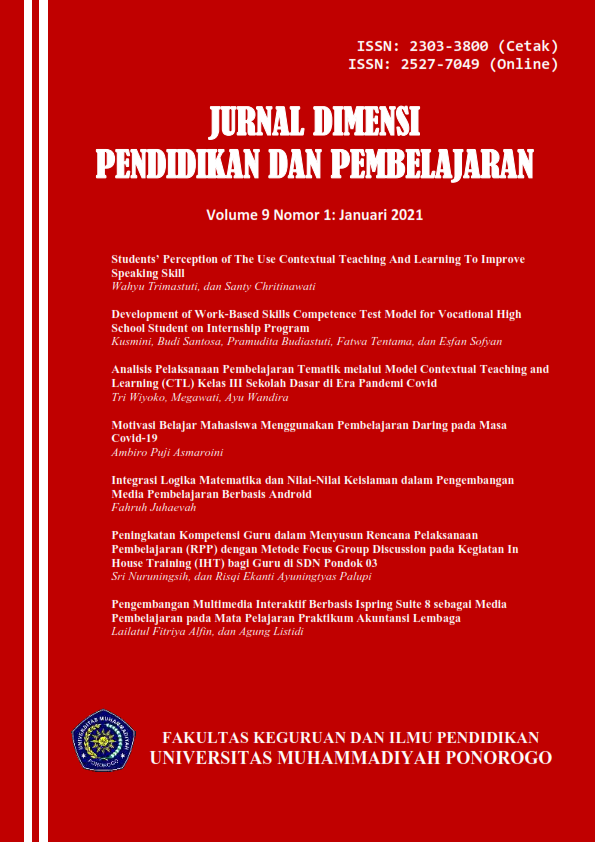
Analisis Pelaksanaan Pembelajaran Tematik Menggunakan Model Contextual Teaching and Learning (CTL) Kelas III Sekolah Dasar di Era Pandemi Covid-19
DOI:
https://doi.org/10.24269/dpp.v9i1.3471Abstract
The success of learning can be shown by the mastery of learning objectives by students. But what about the learning process that occurred during the Covid-19 pandemic. Is it possible that the lesson planning by the teacher at the beginning of the semester can be carried out optimally. This type of research is qualitative research. The research was conducted at SD Negeri 82/II Dusun Panjang in class III. Data obtained by making observations. The researcher went to the research location by looking at the teacher's teaching activities in Theme 6. Energy and Change. Observation of learning towards initial, core, and closing activities. The results of the analysis showed that the implementation of thematic learning with the CTL model that was applied in grade III of Elementary Schools in the Era of the COVID-19 Pandemic was well prepared by the teacher. This can be seen from the learning implementation plan that has been prepared. However, at the time of its implementation there were still obstacles, so that the learning targets to be achieved were not optimal. The stages in CTL are not carried out as planned in the Learning Implementation Plan.
Downloads
References
Arman, A. (2016). Upaya Peningkatan Kompetensi Guru Dalam Menyusun Rencana Pelaksanaan Pembelajaran Melalui Supervisi Akademik Kepala Sekolah Di SMAN 1 Lembah Melintang Kabupaten Pasaman Barat. Jurnal Manajemen Pendidikan Vol. I No.1 Th. 2016
Aulia, Vivi. (2019). Refleksi Pelaksanaan Pembelajaran pada Praktik Mengajar Mahasiswa di Jenjang SD Sederajat untuk Mata Pelajaran Bahasa Inggris. BRILIANT: Jurnal Riset dan Konseptual, Volume 4 Nomor 3, Agustus 2019
Budiman, A & Munfarid, M. (2017). Penerapan Metode Kontekstual Inkuiri Dalam Pembelajaran Pendidikan Agama Islam. Jurnal Educan, Vol. 01, No. 01, Februari 2017
Daryanto. (2012). Model Pembelajaran Inovatif. Yogyakarta: Gava Media
Depdiknas. (2002). Penyempurnaan Kurikulum 1994. Jakarta: Depdikbud
Dyer, Laura. (2004). Meningkatkan Kemampuan Bicara Anak. Jakarta: PT Bhuana Ilmu Populer
Hidayat, Muhtar S. (2012). Pendekatan Kontekstual Dalam Pembelajaran. Jurnal Insania Vol. 17, No. 2, Mei - Agustus2 2012
Majid, A. (2014). Strategi Pembelajaran. Bandung: PT Remaja Rosdakarya.
Mansor, A. N., Eng W. K., Rasul M. S., Hamzah M.I.M., & Hamid, A.H A. (2012). Effective Classroom Management. Journal of International Education Studies, Vol 5 No 5
Mawardi. (2019). Optimalisasi Kompetensi Guru Dalam Penyusunan Rencana Pelaksanaan Pembelajaran. Jurnal Ilmiah DIDAKTIKA Agustus 2019 VOL. 20, NO. 1, 69- 82
Muslich, M. (2007). KTSP Pembelajaran berbasis kompetensi dan kontektual, panduan bagi guru, kepala sekolah dan pengawas. Jakarta: Bumi Aksara
Muchsin.(2016). Model Pengembangan Learning Community Dalam Pembelajaran Bahasa Inggris Terhadap Peningkatkan Prestasi Belajar Siswa. Jurnal Pengembangan Masyarakat Islam Vol. 9, No. 1 Februari 2016.
Mudjiono. (2009). Belajar dan Pembelajaran. Jakarta: PT Rineka.
Peraturan Menteri Pendidikan Dan Kebudayaan Nomor 22 Tahun 2016 Tentang Standar Proses Pendidikan Dasar Dan Menengah
Rusman. (2012). Model-model Pembelajaran. Jakarta: Raja Garifindo Persada Republik Indonesia, Undang-undang Republik Indonesia Nomor 20 tahun 2003 tantang Sistem Pendidikan Nasional, hlm. 6.
Saun, S. (2015). Penggunaan Strategi Bertanya Oleh Mahasiswa Pendidikan Bahasa Inggris UNP Padang Dalam Praktik Micro Teaching. Lingua Didaktika, Volume 9 No 1, Desember 2015
Subekti, M.A. (2011). Teknik Pemodelan. http://odazzander.blogspot.com/2011/09/ teknik-pemodelan.html
Sumaryanta, Pradjitno, E., dan Agustina, T. (2018). Modul Pengembangan Keprofesian Berkelanjutan Sekolah Dasar Kelas Awal Terintegras Penguatan Pendidikan Karakter. Jakarta: Direktorat Jenderal Guru danTenaga Kependidikan Kementerian Pendidikan dan Kebudayaan.
Trianto. (2015). Model Pembelajaran Terpadu. Surabaya: PT. Bumi Aksara
Umami, M. (2018). Penilaian Autentik Pembelajaran Pendidikan Agama Islam dan Budi Pekerti dalam Kurikulum 2013. Jurnal Kependidika (JK) 6 (2) (2018) 222-232.
Downloads
Published
Issue
Section
License
Copyright
Authors who publish their manuscripts in this journal agree to the following terms:
- The copyright on each article belongs to the author.
- The author acknowledges that Jurnal Dimensi Pendidikan dan Pembelajaran has the right to be the first to publish under a Creative Commons Attribution 4.0 International (Attribution 4.0 International CC BY 4.0) license.
- Authors may submit articles separately, arranging for the non-exclusive distribution of manuscripts that have been published in this journal to other versions (e.g., sent to the author's institutional repository, publication into books, etc.), acknowledging that the manuscript was first published in the Jurnal Dimensi Pendidikan dan Pembelajaran.
License
Use of the article will be governed by the Creative Commons Attribution license as currently published under the Creative Commons Attribution 4.0 International License(Attribution 4.0 International (CC BY 4.0).
This license permits anyone to copy and redistribute this material in any form or format, compose, modify, and make derivatives of this material for any purpose, including commercial purposes, as long as they give credit to the author for the original work.

_001.jpg)


