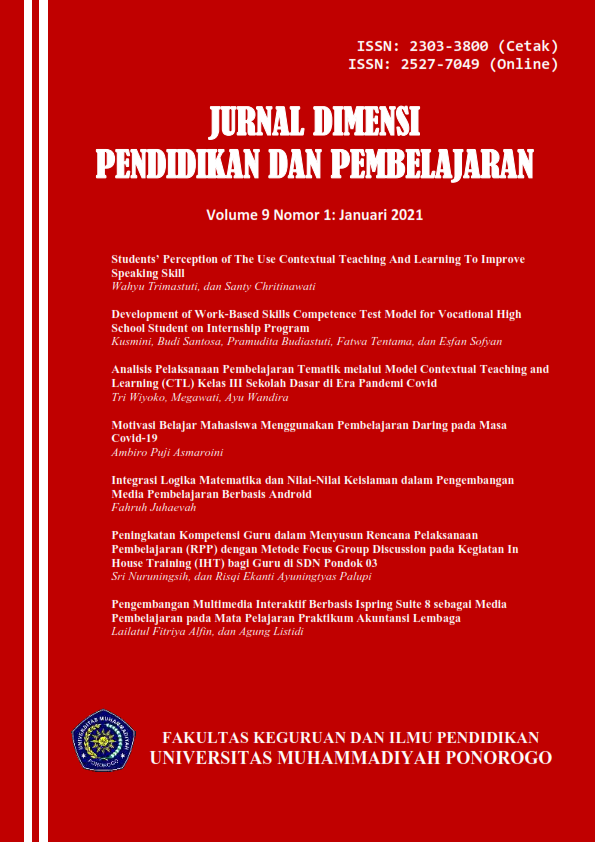
Students’ Perception of the Use Contextual Teaching and Learning to Improve Speaking Skill
DOI:
https://doi.org/10.24269/dpp.v9i1.3478Abstract
The main objective of the research is to find out whether contextual teaching and learning can improve speaking skill or not. The descriptive quantitative method was employed in this research. The population of the research was the students of accounting computerized of Piksi Ganesha Polytechnic. The samples of the research were accounting computerized of AKE-K31/16 which consists of twenty four students. To collect the data, the writer used questionnaire to find out the students’ perception toward the use of contextual teaching and learning and speaking test to know whether the final test score of the students have a significant progress or not. Contextual teaching and learning offers a highly natural and powerful means to convey, learn, and retain information. It can be seen that students were encouraged to be actively and motivately in every activity. Based on the reserach finding, it can be conclude that contextual teaching and learning can improve speaking skill and give good atmosphere in teaching learning process. Therefore, it is suggested that: (1) it is better to apply contextual teaching and learning to improve speaking skill; (2) the students are expected to be more active in the teaching and learning process in order to improve their speaking skill; (3) this result of the study can be used as a beginning step to conduct a further research.
Downloads
References
to Research in Education. New York:
Mc.Graw Hill
Bailey, Kathleen M. 2005. Practical English Language Teaching: Speaking. New York: Mc. Graw Hill Companies Inc.
Berns, Robert G. and Patricia M. Erickson. 2002. Contextual Teaching and Learning: Preparing Students for the New Economy. Available at www.nccte.com. It was accessed on November 22, 2017.
Burns, A & Joyce, H. (1997). Focus on Speaking. Sydney: National center for EnglishLanguage Teaching and Reserach.
Calka, Aneta. 2011. Speaking and Instructed Foreign Language Acquisition – Pronunciation Learning Strategies: Identification and Classification. Bristol: MPG Books Group.
Florez, M.A. (1999). “Improving Adult English Language Learning Learners’ Speaking Skillsâ€.ERIC Digest (Eric Document Reproduction Service No. ED: 435204)
Gass, S & Varionis, E (1994). “Input, Interaction and Second Language Productionâ€. Studies in Second Language Acquisition:MPG Books Group
Harris, David P. 1969. Testing English as a Second Language. New York: McGraw Hill.
Hilferty,A. (2005). “The Relationship between Reading and Speaking Skillsâ€. Focus on Basic. Available at http://www.ncsall.net/?id=328, was accessed on November 15, 2017.
Hughes, Arthur. 2004. Testing for Language Teachers. United Kingdom: Cambridge University Press.
Hughes, Rebecca. 2002. Teaching and Researching Speaking. London: Pearson Education.
Johnson, Elaine B. 2002. Contextual Teaching & Learning; What it is and why it‘s here to stay.California: Corwin Press, Inc.
Nunan, David. 1999. Second Language Teaching and Learning.Boston: Heinle & Heinle Publishers.
Nunan, David. 1989. Language Teaching Methodology; A Textbook for Teachers. New Jersey: Prentice Hall, Inc.
O’Sullivan, Barry. 2012. Second Language Assessment. New York: Cambridge University Press.
Ortiz, Araceli Martinez. 2005. Engineering Design as a Contextual Learning and Teaching Framework: How Elementary Students Learn Math and Technology Literacy. Available at http://www.iteea.org/Conference/ PATT/PATT19/Aracelifinal19.pdf. It was accessed on November 21, 2017.
Pollard, Lucy. 2008. Lucy Pollard’s Guide to Teaching English: A Book to Help You through Your First Two Years in Teaching. Lucy Pollard’s e-book.
Regina, S. (1997). English Language Arts: A Curriculum Guide for the Middle Level (Grades 6-9). Canada: Saskatchewan Education.
Trachsel,M. & Severino. C. (2004). The Challenges of Integrating and Balancing Speaking and Writing in First-Year Rhetoric Classes. http://www.mhhe.com/socscience/english/tc/trachselANDseverino/trachselANDseverino_module.html, accessed on November 15, 2017
Zhang. 2010. Cooperative Learning in the Classroom. Va: Curriculum Development
Downloads
Published
Issue
Section
License
Copyright
Authors who publish their manuscripts in this journal agree to the following terms:
- The copyright on each article belongs to the author.
- The author acknowledges that Jurnal Dimensi Pendidikan dan Pembelajaran has the right to be the first to publish under a Creative Commons Attribution 4.0 International (Attribution 4.0 International CC BY 4.0) license.
- Authors may submit articles separately, arranging for the non-exclusive distribution of manuscripts that have been published in this journal to other versions (e.g., sent to the author's institutional repository, publication into books, etc.), acknowledging that the manuscript was first published in the Jurnal Dimensi Pendidikan dan Pembelajaran.
License
Use of the article will be governed by the Creative Commons Attribution license as currently published under the Creative Commons Attribution 4.0 International License(Attribution 4.0 International (CC BY 4.0).
This license permits anyone to copy and redistribute this material in any form or format, compose, modify, and make derivatives of this material for any purpose, including commercial purposes, as long as they give credit to the author for the original work.
_001.jpg)


