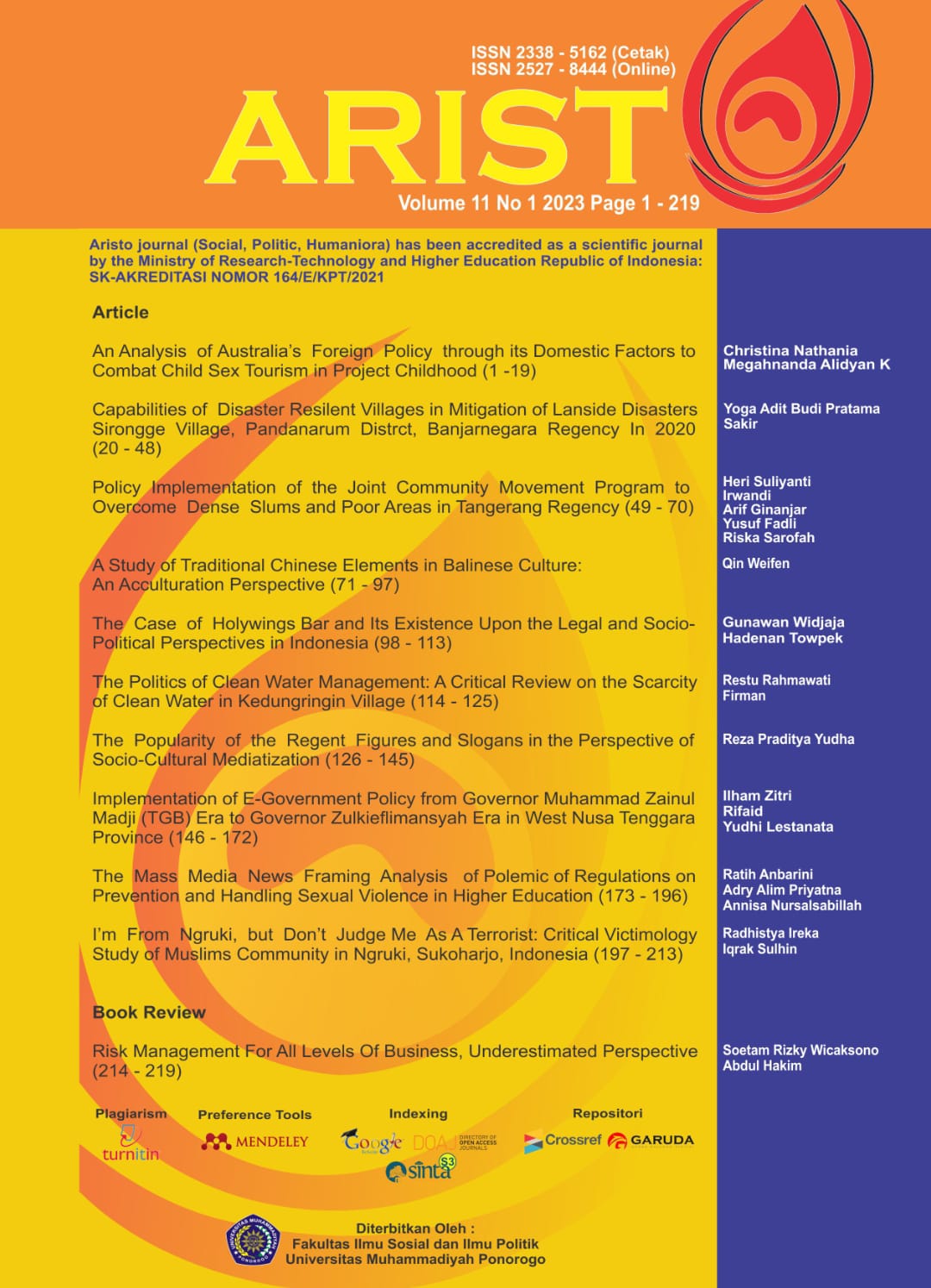
I’m From Ngruki, but Don’t Judge Me As A Terrorist: Critical Victimology Study of Muslims Community in Ngruki, Sukoharjo, Indonesia
DOI:
https://doi.org/10.24269/ars.v11i1.6186Abstract
The Ngruki area has been in the spotlight after the Bali bombings and several acts of terrorism. Causes there are perpetrators who are caught by police in Ngruki. Also, there is a boarding school led by Abu Bakar Bakar Ba'asyir who become convicts of terrorism. This puts Ngruki Muslims associated with, even often accused of radicalism and terrorism. Ultimately, it made them uncomfortable with the behavior. The problem is accused of the Ngruki community by other people, making them perceive suffering. It is indicate that they experience victimization. This paper aims to describe the experience of the Ngruki people, who received victimization. The question is, how is the victimization experienced by the Ngruki community?. This study uses the conceptual approach of critical victimology initiated by Sandra Walkalate. This study uses a qualitative method to explore the victimization experiences of from the Ngruki community. by conducting in-depth interviews with five people who experience bad behavior due to their Ngruki identity. This study finds that their identity as Ngruki makes them victims. They get bullying, ribbing, and even discrimination from other people. Nevertheless, there are no resistances, and realize that is normal. Its shows that found "misrecognize†such as symbolic violence.
Downloads
References
Ballinger, A., Chakraborti, N., Condry, R., Elias, R., Gallo, C., Katz, R., Lippens, R., McConnachie, K., McEvoy, K., & McGarry, R. (2016). Reconceptualizing critical victimology: Interventions and possibilities (C. Spencer, Dale & S. Walklate (Eds.)). Lexington Books.
Bernburg, J. (2009). Labeling Theory (pp. 187–207). https://doi.org/10.1007/978-1-4419-0245-0_10
Bourdieu, P. (1979). Symbolic power. Critique of Anthropology, 4(13–14), 77–85.
Bourdieu, P. (1989). Social space and symbolic power. Sociological Theory, 7(1), 14–25.
Bourdieu, P. (1990). The logic of practice. Stanford university press.
Bourdieu, P. (1991). Language and symbolic power. Harvard University Press.
Bourdieu, P., & Wacquant, L. J. D. (1992). An invitation to reflexive sociology. University of Chicago press.
Chomsky, N. (2017). Pirates and Emperors.
Corrigan, P. W., & Watson, A. C. (2002a). The paradox of self-stigma and mental illness. Clinical Psychology: Science and Practice, 9(1), 35.
Corrigan, P. W., & Watson, A. C. (2002b). Understanding the impact of stigma on people with mental illness. World Psychiatry : Official Journal of the World Psychiatric Association (WPA), 1(1), 16–20.
Council, H. R. (2020). A WORKING DEFINITION OF ISLAMOPHOBIA A Briefing Paper prepared For the Special Rapporteur on freedom of religion or belief Preparation for the report to the 46 th Session of Human Rights Council November 2020 By Professor Imran Awan and Dr Irene Zempi. November.
Creswell, J. W. (1998). Qualitative inquiry and research design: Choosing among five traditions. In Qualitative Health Research (Vol. 9, Issue 5).
Ewald, U., & TurkovicfEds, K. (2006). What victimology has to offer in the fight against terrorism. Large-Scale Victimisation as a Potential Source of Terrorist Activities: Importance of Regaining Security in Post-Conflict Societies, 13, 54.
Foucault, M. (1980). Power/knowledge: Selected interviews and other writings, 1972-1977. Vintage.
Hatzenbuehler, M. L., Phelan, J. C., & Link, B. G. (2013). Stigma as a fundamental cause of population health inequalities. American Journal of Public Health, 103(5), 813–821.
Henry, S., & Milovanovic, D. (1996). Constitutive criminology.
Henry, S., & Milovanovic, D. (2000). Constitutive criminology: Origins, core concepts, and evaluation. Social Justice, 27(2 (80), 268–290.
Joyce, S. L. P. (2005). The discursive construction of lesbian, gay, and bisexual identity: How symbolic violence and information capital mediate the comingout process.
Karmen, A. (2010). Crime Victims: An Introduction. Belmont, CA: Wadsworth.
Kaufman, S. B., & Niner, H. (2019). Muslim Victimization in the Contemporary US: Clarifying the Racialization Thesis. Critical Criminology, 27(3). https://doi.org/10.1007/s10612-018-09428-2
Krisnawati, E. (2021). Sejarah Peristiwa 9/11 WTC: Kronologi Serangan Teroris 11 September Baca selengkapnya di artikel “Sejarah Peristiwa 9/11 WTC: Kronologi Serangan Teroris 11 Septemberâ€, https://tirto.id/gjjX. Tirto.Id. https://tirto.id/sejarah-peristiwa-9-11-wtc-kronologi-serangan-teroris-11-september-gjjX
Link, B. G., & Phelan, J. (2014). Stigma power. Social Science & Medicine, 103, 24–32.
Mawby, R., & Walklate, S. (1994). Critical victimology: International perspectives. Sage.
McGarry, R., & Walklate, S. (2015). Victims: Trauma, testimony and justice. In Victims: Trauma, Testimony and Justice. https://doi.org/10.4324/9780203727379
McGowan, W. (2016). Critical terrorism studies, victimisation, and policy relevance: compromising politics or challenging hegemony? Critical Studies on Terrorism, 9(1), 12–32.
McGowan, W. (2022). Victims of Political Violence and Terrorism. In Victims of Political Violence and Terrorism. https://doi.org/10.4324/9781003154020
Miers, D. (1989). Positivist Victimology: A Critique. International Review of Victimology, 1(1), 3–22. https://doi.org/10.1177/026975808900100102
Miers, D. (1990). Positivist victimology: A critique part 2: Critical victimology. International Review of Victimology, 1(3), 219–230.
Moukarbel, N. (2009). Sri Lankan housemaids in Lebanon: a case of’symbolic violence’and’everyday forms of resistance’. Amsterdam University Press.
Mythen, G., Walklate, S., & Khan, F. (2009). “I’m a Muslim, but I’m not a terroristâ€: Victimization, risky identities and the performance of safety. British Journal of Criminology, 49(6). https://doi.org/10.1093/bjc/azp032
O’Leary, N. (2021). A Victim Community: Stigma and the Media Legacy of High-profile Crime. Springer.
Rock, P. (2012). On Becoming a Victim. In C. H. Young. In New Visions of Crime Victims (pp. 1–22). Hart Publishing. https://doi.org/http://dx.doi.org/10.5040/9781472559258.ch-001
Sturzaker, J., & Shucksmith, M. (2011). Planning for housing in rural England: discursive power and spatial exclusion. Town Planning Review, 82(2), 169–195.
Suri, R. I. (2009). Dampak Berita Terorisme (Studi Deskriptif Kualitatif mengenai Dampak Berita Terorisme terhadap Masyarakat sekitar Pondok Pesantren Al Mukmin Ngruki Sukoharjo).
Taskarina, L. (2020). Women victimization on Islamic State of Iraq and Syria (ISIS): A critical analysis on terrorist wives. Jurnal Keamanan Nasional, 6(1), 1–23.
Victimology, T. A. C. (1992). Towards a Critical Victimology. In Towards a Critical Victimology. https://doi.org/10.1007/978-1-349-22089-2
Walklate, S. (2002). So who are the victims now? British Journal of Community Justice, 1, 47–64.
Walklate, S. (2007). Imagining the victim of crime. 189.
Walklate, S. (2012). Who is the victim of crime? Paying homage to the work of Richard Quinney. Crime, Media, Culture, 8(2), 173–184.
Walklate, S. (2015). Jock Young, Left Realism and Critical Victimology. Critical Criminology, 23(2). https://doi.org/10.1007/s10612-015-9274-7
Walklate, S. (2019). 14. Researching Victims of Crime: Critical Victimology. In Realist Criminology. https://doi.org/10.3138/9781487575854-016
Wibowo, I. (2015). Terorisme dalam pemberitaan media, Analisis wacana terorisme (Yoyoh Hereyah (Ed.)).
Windiani, R. (2016). Persepsi Masyarakat Terhadap “Label†Wilayah Basis Teroris (Studi Kasus Persepsi Masyarakat Sola Raya). Jurnal Litbang Provinsi Jawa Tengah, 14(1), 121–132.
Woolford, A., & Wolejszo, S. (2006). Collecting on moral debts: Reparations for the Holocaust and Pořajmos. Law & Society Review, 40(4), 871–902.
Downloads
Published
Issue
Section
License
Authors Who Publish whit this journal agree to the following term :
Copyright on any article is retained by the Journal
- Author grant the journal right of first publication with the work simultaneously licensed under a Creative Commons Attribution License that allows others to share the work with an acknowledgement of the work's authorship and initial publication in this;
- Authors are able to enter into separate, additional contractual arrangements for the non-exclusive distribution of the journal's published version of the work (e.g., post it to an institutional repository or publish it in a book), with an acknowledgement of its initial publication in this journal;
- Authors are permitted and encouraged to post their work online (e.g., in institutional repositories or on their website) prior to and during the submission process, as it can lead to productive exchanges, as well as earlier and greater citation of published work;
- Every accepted manuscript should be accompanied by Copyright Transfer Agreement (CTA), prior to the article publication. CTA can be downloaded here;
=====================================================================================================
Penulis yang mempublikasikan naskahnya pada Jurnal ini menyetujui ketentuan berikut:
Hak cipta pada setiap artikel adalah milik jurnal.
- Penulis mengakui bahwa Jurnal ARISTO berhak sebagai mempublikasikan pertama kali dengan bekerja secara bersamaan dibawah Creative Commons Attribution License yang memungkinkan orang lain untuk membagi pekerjaan dengan pengakuan dari pengarang dan publikasi pertama dalam jurnal ARISTO;
- Penulis dapat memasukan tulisan secara terpisah, mengatur distribusi non-ekskulif  dari naskah yang telah terbit di jurnal ini kedalam versi yang lain (misal: dikirim ke respository institusi penulis, publikasi kedalam buku, dll), dengan mengakui bahwa naskah telah terbit pertamakali pada Jurnal ARISTO;
- Penulis diperbolehkan dan didorong untuk mengirimkan pekerjaan mereka secara daring (misal melalui respositories atau website instansi penulis) sebelum atau selama proses pengiriman pada Jurnal ARISTO berlangsung, ini dapat menjadikan pertukaran informasi yang sangat produktif, dan serta menjadikan kutipan yang banyak dari publikasi;
- Setiap naskah yang diterima wajib menyertakan Perjanjian Pemindahan Hakcipta (Copyright Transfer Agreement/CTA), sebelum artikel diterbitkan. CTA dapat diunduh di sini


