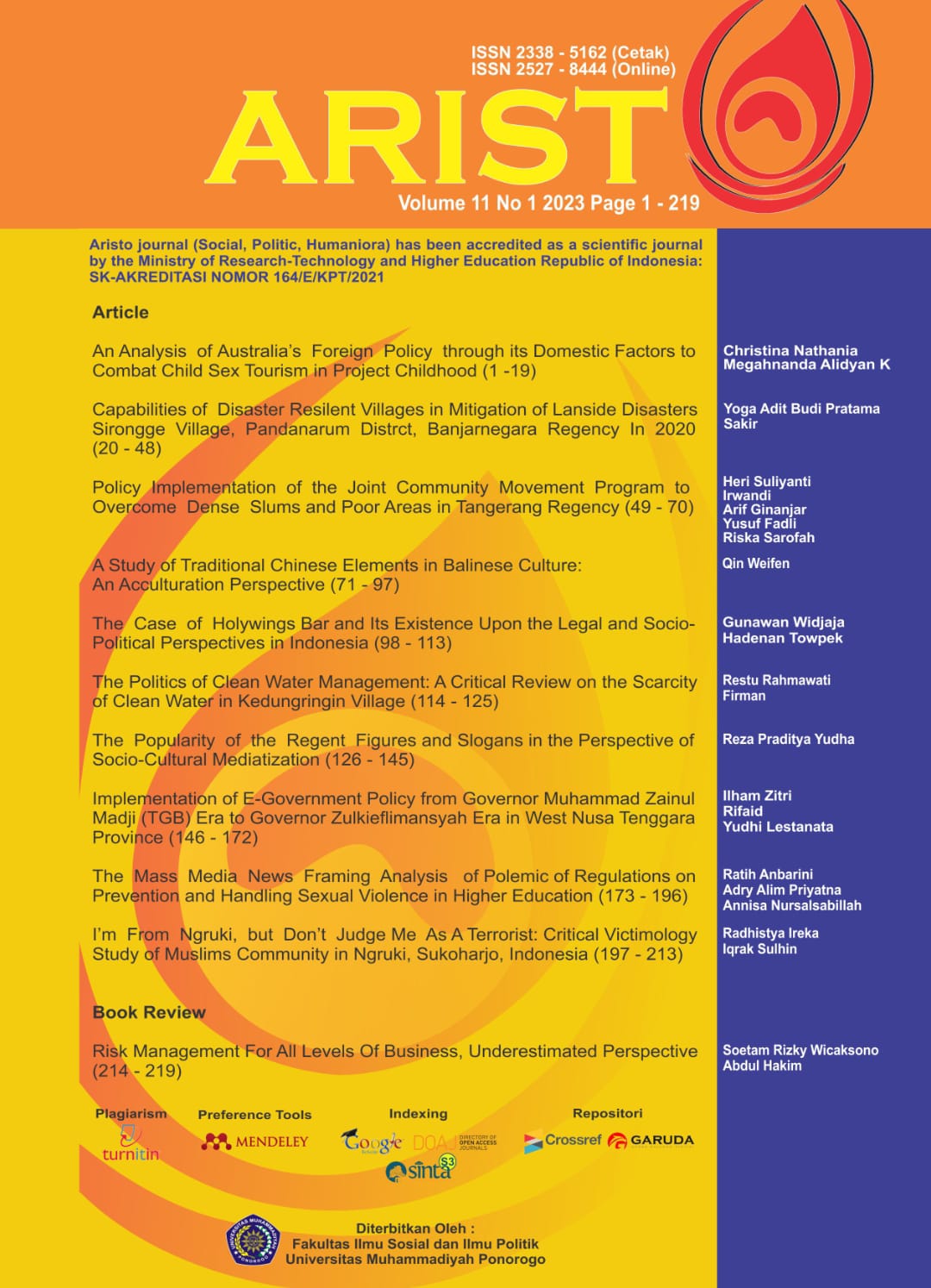
An Analysis of Australia’s Foreign Policy through its Domestic Factors to Combat Child Sex Tourism in Project Childhood
DOI:
https://doi.org/10.24269/ars.v11i1.5318Abstract
2010 was the year Australia initiated and signed Project Childhood, a grant and partnership to protect children from sexual exploitation due to travel and tourism. Four countries in the Greater Mekong Subregion, Thailand, Cambodia, Laos, and Vietnam, are in a sub-region where child sex tourism occurs a lot. The phenomenon of transnational borders will involve sending country as the country of traveling child sex offenders, and receiving country for victims coordinates to make serious law enforcement regarding this issue. In formulating foreign policy, domestic factors are one way of looking at why Australia provides funding, assistance, and initiate international cooperation to combat child sex tourism in GMS. Through this research, the authors will explain the domestic factors that influence Australia in initiating Project Childhood as its foreign policy, using domestic determinants as the level of analysis. Then, it will be divided into 3 sub-determinants, they are; highly stable, demonstrating an Australian responsibility for TCSO originating in the country. This is related to one of the demographic components that cause migration problems. Moderately stable, in relation to the domestic reforms that are actively being carried out in the context of enforcing the extraterritoriality. The last, unstable, the factor of public opinion which also has played an important role so that the government gives attention to this phenomenonDownloads
Download data is not yet available.
References
Global Study On Sexual Exploitation Of Children In Travel And Tourism 2016. (n.d.).
Project Childhood Prevention Pillar Project Design Document. (n.d.).
Australian Government. (2017). Stopping Child Sexual Exploitation. https://www.homeaffairs.gov.au/criminal-justice/files/stopping-child-exploitation-brochure.pdf
Brown, R., Napier, S., & Smith, R. G. (2020). Trends & issues in crime and criminal justice Australians who view live streaming of child sexual abuse: An analysis of financial transactions.
Child Exploitation and Online Protection Centre. (2012). Threat Assessment of Child Sexual Exploitation and Abuse. https://childhub.org/sites/default/files/library/attachments/1469_CEOPThreatA_2012_190612_web_original.pdf
Child Safe Tourism. (2014, July 31). Farewell from Project Childhood Prevention Pillar. http://childsafetourism.org/farewell-project-childhood-prevention-pillar/
Crispin, V., & Thompstone, G. (2011). The Commercial Sexual Exploitation of Children in Lao PDR Child Protection Systems Mapping and Analysis in West Africa View project [Report on The Commercial Sexual Exploitation of Children in LAO PDR] Research Study on the Commercial Sexual Exploitation of Children in Lao PDR. https://doi.org/10.13140/RG.2.1.4143.2805
Curley, M. (2014). Combating Child Sex Tourism in South-east Asia: Law Enforcement Cooperation and Civil Society Partnerships. Journal of Law and Society, 41(2).
Curley, M. (2019). Exporting Harmful People. In The State and Cosmopolitan Responsibilities (pp. 119–146). Oxford University Press. https://doi.org/10.1093/oso/9780198800613.003.0007
Davy, D. (2014). Understanding the complexities of responding to child sex trafficking in Thailand and Cambodia. International Journal of Sociology and Social Policy, 34, 793–816. https://doi.org/10.1108/IJSSP-10-2013-0103
Down to Zero Alliance. (n.d.). Annual Report 2018. Retrieved June 14, 2022, from https://www.datocms-assets.com/22233/1590138755-downtozeroannualreport2018.pdf
Finkel, R., & Finkel, M. L. (2015). The “dirty downside†of global sporting events: Focus on human trafficking for sexual exploitation. In Public Health (Vol. 129, Issue 1, pp. 17–22). Elsevier B.V. https://doi.org/10.1016/j.puhe.2014.11.006
George, B. P., & Panko, T. R. (2011). Child sex tourism: Facilitating conditions, legal remedies, and other interventions. Vulnerable Children and Youth Studies, 6(2), 134–143. https://doi.org/10.1080/17450128.2010.521599
Hawke, A. & & R. A. (n.d.). Global Study on Sexual Exploitation of Children in Travel and Tourism 2016. Retrieved June 15, 2022, from https://ecpat.org/wp-content/uploads/2021/08/Global-Report-Offenders-on-the-Move.pdf
Holt, K., & Massey, C. (2013). Sexual Preference or Opportunity: An Examination of Situational Factors by Gender of Victims of Clergy Abuse. Sexual Abuse: Journal of Research and Treatment, 25(6), 606–621. https://doi.org/10.1177/1079063211425690
Hossain, A. A. (2011). Gendering Cross-Border Networks in the Greater Mekong Subre-gion: Drawing Invisible Routes to Thailand. ASEAS-Austrian Journal of South-East Asian Studies, 4(2), 273–289. https://doi.org/10.4232/10.ASEAS-4.2-5
Hudson, V. M. (2020). Foreign policy analysis : classic and contemporary theory: Vol. 3rd Edition. Rowman & Littlefield Pub
Hussain, Z. Z. (n.d.). The effect of domestic politics on foreign policy decision making Written by Zaara Zain Hussain The effect of domestic politics on foreign policy decision making. https://www.e-ir.info/2011/02/07/the-effect-of-domestic-politics-on-foreign-policy-decision-making/
Ireland-Piper, D. (n.d.). Extraterritoriality and the Sexual Conduct of Australians Overseas. In Bond Law Review | Issue (Vol. 2). http://epublications.bond.edu.au/blr/vol22/iss2/2
Koning, A., & van Wilsem, J. (2022). The Context of Sexual Exploitation of Children by Tourists and Travelers: A Cross-National Comparison of Destination Countries and Non-Destination Countries. International Criminal Justice Review. https://doi.org/10.1177/10575677221081875
Koning, A. (2021). Public Perceptions of Child Sexual Exploitation Abroad: A Vignette Experiment on the Influence of Social Distance. Crime and Delinquency. https://doi.org/10.1177/00111287211064786
Kosuri, M., & Jay, J. (n.d.). Child Sex Tourism: A Violation of Children’s Rights.
Kugler, T. (2016). Demography and international relations: Economics, politics, sociology, and conflict. In Advancing Interdisciplinary Approaches to International Relations (pp. 229–261). Springer International Publishing. https://doi.org/10.1007/978-3-319-40823-1_8
Machado De Lima, B., & Valério, D. (n.d.). Universidade Federal Fluminense. http://www.redalyc.org/articulo.oa?id=361441674011
Mahboob HOSSAIN, D. (2011). Qualitative Research Process (Vol. 7).
Matthews, A., & World Vision Australia. (n.d.). Child safe tourism : the tourist perspective.
McNicol, J., & Schloenhardt, A. (2012). Australia’s Child Sex Tourism Offenmattces. Current Issues in Criminal Justice, 23(3), 369–392. https://doi.org/10.1080/10345329.2012.12035930
Mekinc, J., & Music, K. (2015). Sexual Exploitation of Children in The Tourism – The Dark Side of Tourism. Innovative Issues and Approaches in Social Sciences, 8(2), 64–85. https://doi.org/10.12959/issn.1855-0541.iiass-2015-no2-art04
Mercer, P. (2010, June 7). Australia in sex-tourism campaign. BBC. https://www.bbc.com/news/10252165
Nassaji, H. (2015). Qualitative and descriptive research: Data type versus data analysis. In Language Teaching Research (Vol. 19, Issue 2, pp. 129–132). SAGE Publications Ltd. https://doi.org/10.1177/1362168815572747
Nicolls, M., & Casey, S. (2013). Independent Mid-Term Evaluation Report Project Childhood: Child Sexual Exploitation in Travel and Tourism (CSETT), Mekong Sub-Region Thailand, Cambodia, Viet Nam, and Lao PDR.
OHCHR. (n.d.). HRC22 Side Event on Child Sex Tourism Presentation by Australian Deputy Permanent Representative Nicholas Purtell. Retrieved July 8, 2022, from https://www.ohchr.org/sites/default/files/Documents/Issues/Children/Childrenexplotation/NickPurtell-Australian_presentation.pdf
Rafferty, Y. (2013). Child Trafficking and Commercial Sexual Exploitation: A Review of Promising Prevention Policies and Programs. American Journal of Orthopsychiatry, 83(4), 559–575. https://doi.org/10.1111/ajop.12056
Roberts, C. N. (2017). Domestic Policy Actors and Australian Foreign Policy A public policy approach to analysing the making of Australian foreign policy.
Selvarajah, C. (2014). Foreign Aid Imperatives In The Greater Mekong Subregion: Case Studies Of Australian, Japanese And Thai Aid Coordination. In Asia-Pacific Development Journal (Vol. 21, Issue 1).
Sofian, A. (n.d.). Legal Aspect of Child Sex Tourism in ASEAN. www.ecpat.net/worldcongressIII/PDF/Thematic/SEX_IN_TOURISM_concept_note.pdf
The Jakarta Post. (2017). Australia introduces tough new laws on child sex tourism . https://www.thejakartapost.com/news/2017/12/13/australia-introduces-tough-new-laws-on-child-sex-tourism.html
UNODC Regional Office for Southeast Asia and the Pacific. (2013, June 21). Better regional coordination needed to fight online sexual abuse of children in the Greater Mekong Sub-Region. UNODC.
UNODC Regional Office for Southeast Asia and the Pacific. (2012, March 14). Strengthening Thai laws to fight travellers who sexually abuse children.
Voelkel, I. (n.d.). Child Sex Tourism and the Lack of Deterrence that Drives the Child Sex Tourism and the Lack of Deterrence that Drives the Problem Problem. https://epublications.regis.edu/theses/844
Washington, R. (2018). Treating The International Child Sex Tourism Industry As a Crime Against Humanity. http://www.un.org/apps/news/story.asp?News
Project Childhood Prevention Pillar Project Design Document. (n.d.).
Australian Government. (2017). Stopping Child Sexual Exploitation. https://www.homeaffairs.gov.au/criminal-justice/files/stopping-child-exploitation-brochure.pdf
Brown, R., Napier, S., & Smith, R. G. (2020). Trends & issues in crime and criminal justice Australians who view live streaming of child sexual abuse: An analysis of financial transactions.
Child Exploitation and Online Protection Centre. (2012). Threat Assessment of Child Sexual Exploitation and Abuse. https://childhub.org/sites/default/files/library/attachments/1469_CEOPThreatA_2012_190612_web_original.pdf
Child Safe Tourism. (2014, July 31). Farewell from Project Childhood Prevention Pillar. http://childsafetourism.org/farewell-project-childhood-prevention-pillar/
Crispin, V., & Thompstone, G. (2011). The Commercial Sexual Exploitation of Children in Lao PDR Child Protection Systems Mapping and Analysis in West Africa View project [Report on The Commercial Sexual Exploitation of Children in LAO PDR] Research Study on the Commercial Sexual Exploitation of Children in Lao PDR. https://doi.org/10.13140/RG.2.1.4143.2805
Curley, M. (2014). Combating Child Sex Tourism in South-east Asia: Law Enforcement Cooperation and Civil Society Partnerships. Journal of Law and Society, 41(2).
Curley, M. (2019). Exporting Harmful People. In The State and Cosmopolitan Responsibilities (pp. 119–146). Oxford University Press. https://doi.org/10.1093/oso/9780198800613.003.0007
Davy, D. (2014). Understanding the complexities of responding to child sex trafficking in Thailand and Cambodia. International Journal of Sociology and Social Policy, 34, 793–816. https://doi.org/10.1108/IJSSP-10-2013-0103
Down to Zero Alliance. (n.d.). Annual Report 2018. Retrieved June 14, 2022, from https://www.datocms-assets.com/22233/1590138755-downtozeroannualreport2018.pdf
Finkel, R., & Finkel, M. L. (2015). The “dirty downside†of global sporting events: Focus on human trafficking for sexual exploitation. In Public Health (Vol. 129, Issue 1, pp. 17–22). Elsevier B.V. https://doi.org/10.1016/j.puhe.2014.11.006
George, B. P., & Panko, T. R. (2011). Child sex tourism: Facilitating conditions, legal remedies, and other interventions. Vulnerable Children and Youth Studies, 6(2), 134–143. https://doi.org/10.1080/17450128.2010.521599
Hawke, A. & & R. A. (n.d.). Global Study on Sexual Exploitation of Children in Travel and Tourism 2016. Retrieved June 15, 2022, from https://ecpat.org/wp-content/uploads/2021/08/Global-Report-Offenders-on-the-Move.pdf
Holt, K., & Massey, C. (2013). Sexual Preference or Opportunity: An Examination of Situational Factors by Gender of Victims of Clergy Abuse. Sexual Abuse: Journal of Research and Treatment, 25(6), 606–621. https://doi.org/10.1177/1079063211425690
Hossain, A. A. (2011). Gendering Cross-Border Networks in the Greater Mekong Subre-gion: Drawing Invisible Routes to Thailand. ASEAS-Austrian Journal of South-East Asian Studies, 4(2), 273–289. https://doi.org/10.4232/10.ASEAS-4.2-5
Hudson, V. M. (2020). Foreign policy analysis : classic and contemporary theory: Vol. 3rd Edition. Rowman & Littlefield Pub
Hussain, Z. Z. (n.d.). The effect of domestic politics on foreign policy decision making Written by Zaara Zain Hussain The effect of domestic politics on foreign policy decision making. https://www.e-ir.info/2011/02/07/the-effect-of-domestic-politics-on-foreign-policy-decision-making/
Ireland-Piper, D. (n.d.). Extraterritoriality and the Sexual Conduct of Australians Overseas. In Bond Law Review | Issue (Vol. 2). http://epublications.bond.edu.au/blr/vol22/iss2/2
Koning, A., & van Wilsem, J. (2022). The Context of Sexual Exploitation of Children by Tourists and Travelers: A Cross-National Comparison of Destination Countries and Non-Destination Countries. International Criminal Justice Review. https://doi.org/10.1177/10575677221081875
Koning, A. (2021). Public Perceptions of Child Sexual Exploitation Abroad: A Vignette Experiment on the Influence of Social Distance. Crime and Delinquency. https://doi.org/10.1177/00111287211064786
Kosuri, M., & Jay, J. (n.d.). Child Sex Tourism: A Violation of Children’s Rights.
Kugler, T. (2016). Demography and international relations: Economics, politics, sociology, and conflict. In Advancing Interdisciplinary Approaches to International Relations (pp. 229–261). Springer International Publishing. https://doi.org/10.1007/978-3-319-40823-1_8
Machado De Lima, B., & Valério, D. (n.d.). Universidade Federal Fluminense. http://www.redalyc.org/articulo.oa?id=361441674011
Mahboob HOSSAIN, D. (2011). Qualitative Research Process (Vol. 7).
Matthews, A., & World Vision Australia. (n.d.). Child safe tourism : the tourist perspective.
McNicol, J., & Schloenhardt, A. (2012). Australia’s Child Sex Tourism Offenmattces. Current Issues in Criminal Justice, 23(3), 369–392. https://doi.org/10.1080/10345329.2012.12035930
Mekinc, J., & Music, K. (2015). Sexual Exploitation of Children in The Tourism – The Dark Side of Tourism. Innovative Issues and Approaches in Social Sciences, 8(2), 64–85. https://doi.org/10.12959/issn.1855-0541.iiass-2015-no2-art04
Mercer, P. (2010, June 7). Australia in sex-tourism campaign. BBC. https://www.bbc.com/news/10252165
Nassaji, H. (2015). Qualitative and descriptive research: Data type versus data analysis. In Language Teaching Research (Vol. 19, Issue 2, pp. 129–132). SAGE Publications Ltd. https://doi.org/10.1177/1362168815572747
Nicolls, M., & Casey, S. (2013). Independent Mid-Term Evaluation Report Project Childhood: Child Sexual Exploitation in Travel and Tourism (CSETT), Mekong Sub-Region Thailand, Cambodia, Viet Nam, and Lao PDR.
OHCHR. (n.d.). HRC22 Side Event on Child Sex Tourism Presentation by Australian Deputy Permanent Representative Nicholas Purtell. Retrieved July 8, 2022, from https://www.ohchr.org/sites/default/files/Documents/Issues/Children/Childrenexplotation/NickPurtell-Australian_presentation.pdf
Rafferty, Y. (2013). Child Trafficking and Commercial Sexual Exploitation: A Review of Promising Prevention Policies and Programs. American Journal of Orthopsychiatry, 83(4), 559–575. https://doi.org/10.1111/ajop.12056
Roberts, C. N. (2017). Domestic Policy Actors and Australian Foreign Policy A public policy approach to analysing the making of Australian foreign policy.
Selvarajah, C. (2014). Foreign Aid Imperatives In The Greater Mekong Subregion: Case Studies Of Australian, Japanese And Thai Aid Coordination. In Asia-Pacific Development Journal (Vol. 21, Issue 1).
Sofian, A. (n.d.). Legal Aspect of Child Sex Tourism in ASEAN. www.ecpat.net/worldcongressIII/PDF/Thematic/SEX_IN_TOURISM_concept_note.pdf
The Jakarta Post. (2017). Australia introduces tough new laws on child sex tourism . https://www.thejakartapost.com/news/2017/12/13/australia-introduces-tough-new-laws-on-child-sex-tourism.html
UNODC Regional Office for Southeast Asia and the Pacific. (2013, June 21). Better regional coordination needed to fight online sexual abuse of children in the Greater Mekong Sub-Region. UNODC.
UNODC Regional Office for Southeast Asia and the Pacific. (2012, March 14). Strengthening Thai laws to fight travellers who sexually abuse children.
Voelkel, I. (n.d.). Child Sex Tourism and the Lack of Deterrence that Drives the Child Sex Tourism and the Lack of Deterrence that Drives the Problem Problem. https://epublications.regis.edu/theses/844
Washington, R. (2018). Treating The International Child Sex Tourism Industry As a Crime Against Humanity. http://www.un.org/apps/news/story.asp?News
Downloads
Published
2022-07-11
Issue
Section
Artikel
License
Authors Who Publish whit this journal agree to the following term :
Copyright on any article is retained by the Journal
- Author grant the journal right of first publication with the work simultaneously licensed under a Creative Commons Attribution License that allows others to share the work with an acknowledgement of the work's authorship and initial publication in this;
- Authors are able to enter into separate, additional contractual arrangements for the non-exclusive distribution of the journal's published version of the work (e.g., post it to an institutional repository or publish it in a book), with an acknowledgement of its initial publication in this journal;
- Authors are permitted and encouraged to post their work online (e.g., in institutional repositories or on their website) prior to and during the submission process, as it can lead to productive exchanges, as well as earlier and greater citation of published work;
- Every accepted manuscript should be accompanied by Copyright Transfer Agreement (CTA), prior to the article publication. CTA can be downloaded here;
=====================================================================================================
Penulis yang mempublikasikan naskahnya pada Jurnal ini menyetujui ketentuan berikut:
Hak cipta pada setiap artikel adalah milik jurnal.
- Penulis mengakui bahwa Jurnal ARISTO berhak sebagai mempublikasikan pertama kali dengan bekerja secara bersamaan dibawah Creative Commons Attribution License yang memungkinkan orang lain untuk membagi pekerjaan dengan pengakuan dari pengarang dan publikasi pertama dalam jurnal ARISTO;
- Penulis dapat memasukan tulisan secara terpisah, mengatur distribusi non-ekskulif  dari naskah yang telah terbit di jurnal ini kedalam versi yang lain (misal: dikirim ke respository institusi penulis, publikasi kedalam buku, dll), dengan mengakui bahwa naskah telah terbit pertamakali pada Jurnal ARISTO;
- Penulis diperbolehkan dan didorong untuk mengirimkan pekerjaan mereka secara daring (misal melalui respositories atau website instansi penulis) sebelum atau selama proses pengiriman pada Jurnal ARISTO berlangsung, ini dapat menjadikan pertukaran informasi yang sangat produktif, dan serta menjadikan kutipan yang banyak dari publikasi;
- Setiap naskah yang diterima wajib menyertakan Perjanjian Pemindahan Hakcipta (Copyright Transfer Agreement/CTA), sebelum artikel diterbitkan. CTA dapat diunduh di sini


