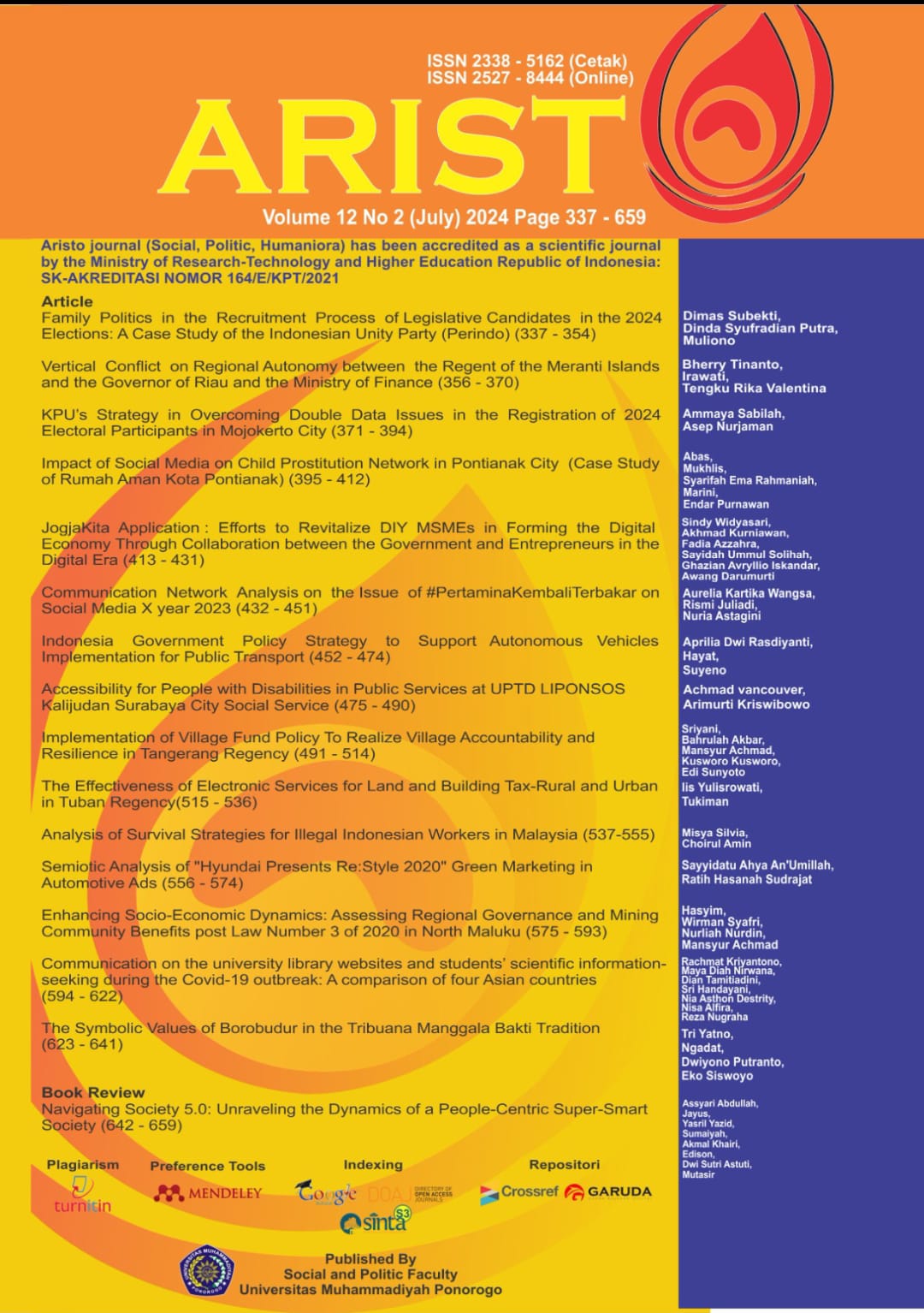
The Symbolic Values of Borobudur in the Tribuana Manggala Bakti Tradition
DOI:
https://doi.org/10.24269/ars.v12i2.8176Abstract
Borobudur Temple is a cultural heritage consisting of various symbols. The Borobudur symbols contain spiritual values and moral education. Tribuana Manggala Bakti is one of a series of Vesak celebration activities in Jatimulyo Village, Kulon Progo. This activity is a Buddhist religious activity with a combination of Javanese culture. This research aims to describe the symbolic values of Borobudur in the Tribuana Manggala Bakti tradition. This research used a holistic descriptive method. The research results stated that Tribuana Manggala Bakti is a religious cultural product containing social, cultural, and spiritual values. Tribuana Manggala Bakti consists of elements of celebration, amisa puja procession, puja bakti, animal release, tree planting, and performing arts. Each of these elements is in harmony with the symbolic values of Borobudur depicted on the reliefs. Jatimulyo Buddhists strive to integrate Buddhist teachings and Javanese culture. Tribuana Manggala Bakti's cultural construction functions as a revitalization of Borobudur values, a means of strengthening Buddhist identity and strengthening interfaith unity. Tribuana Manggala Bakti is an event that transforms religious, artistic and cultural values.
Downloads
References
Anandajoti, B. (2020). Jataka - The Buddha’s Past Birth Stories (CeritaA Kelahiran Lampau Buddha).
Atasoge, A. D. (2019). Simbolisme Ritual Lamaholot Dan Kohesi Sosial. Jurnal Reinha, 11(2), 53–63.
Biggs, M. and D. B. (2011). Communities, Value, conventions and actions. In The Routledge Companion to Research in the Arts. https://doi.org/10.4324/9780203841327
Boty, M. (2017). Masyarakat Multikultural: Studi Interaksi Sosial Masyarakat Islam Melayu Dengan Non Melayu Pada Masyarakat Sukabangun Kel. Sukajadi Kec. Sukarami Palembang. Articel, 1(2), 1–17.
Brimantyawan, A. A. (2022). Pemikiran Immanuel Kant dan Implikasinya dalam Diskursus Pendidikan Akhlak. Jurnal Ilmiah Wahana Pendidikan, 8(6), 100–110. https://doi.org/10.5281/zenodo.6442360
Dadosky, J. D. (2010). Sacred Symbols as Explanatory Geertz, Eliade and Lonergan. Fu Jen International Religious Studies, 4(1), 137–158. http://www.lonerganresource.com/pdf/articles/Dadosky-Sacred_Symbols_as_Explanatory.pdf
Duguma, L., Minang, P., Aynekulu, E., Carsan, S., Nzyoka, J., Bah, A., & Jamnadass, R. (2020). From Tree Planting to Tree Growing: Rethinking Ecosystem Restoration Through Trees. ICRAF Working Paper, 304, 1–36. http://old.worldagroforestry.org/downloads/Publications/PDFS/WP20001.pdf%0Ahttp://dx.doi.org/10.5716/WP20001.PDF
Dwiyono Putranto, Ngadat, Tri Yatno, E. S. (2024). Analisis Pengembangan Desa Wisata Jatimulyo berbasis Agama Buddha. Al Qalam, 18(2), 957–968.
Eko Siswoyo, Ngadat, Tri Yatno, D. P. (2024). Korelasi Nilai-Nilai Agama Buddha pada profil pelajar Pancasila di Sekolah Dasar (Tribuana Manggala Bakti Desa Jatimulyo Kabupaten Kulon Progo). Al Qalam: Jurnal Ilmiah Keagamaan Dan Kemasyarakatan, 18(2), 1432–1451.
Fatimah, T. (2015). The Impacts of Rural Tourism Initiatives on Cultural Landscape Sustainability in Borobudur Area. Procedia Environmental Sciences, 28(July), 567–577. https://doi.org/10.1016/j.proenv.2015.07.067
Fiese, B. H., & Tomcho, T. J. (2001). Finding Meaning in Religious Practices : The Relation Between Religious Holiday Rituals and Marital Satisfaction. 15(4), 597–609.
Hermawan, B., & Rohman, F. (2016). Borobudur Temple as Buddhist Pilgrimage Destination in Indonesia: an Analysis of Factors that Affect Visit Intention. Journal of International Buddhist Studies , 7(2), 98–110. https://www.researchgate.net/publication/326441162
Holl, B. K. D., & Brancalion, P. H. S. (2020). Tree planting is not a simple solution. Science, 368(6491), 580–582.
Latifah. (2024). A Semiotic Branding Analysis of Borobudur : World Spiritual Tourism Destination. Journal of Humanity and Social Justice, 6(1), 60–76.
Latifah dan Ary Budiyanto. (2020). Fangsheng and its Critical Discourse on Environmental Ethics in Buddhist Media. International Journal of Interreligious and Intercultural Studies (IJIIS), 3(1).
Legiyanti, Marjianto, & Prasetyo, L. (2019). Analisis Upacara Tribuana Manggala Bhakti (Studi Interaksionisme Simbolik Umat Buddha Desa Jatimulyo Kecamatan Girimulyo Kabupaten Kulon Progo). Jurnal Agama Buddha Dan Ilmu Pengetahuan, 05(02), 133–152.
Metusala, D., Fauziah, Lestari, D. A., Damaiyani, J., Mas’udah, S., & Setyawan, H. (2020). The identification of plant reliefs in the lalitavistara story of Borobudur temple, central Java, Indonesia. Biodiversitas, 21(5), 2206–2215. https://doi.org/10.13057/biodiv/d210549
Mirjana, M. P. (2009). Holiday Celebration of The Population of Gorna Reka Related To Folk Religion. EthnoAnthropoZoom, 6, 191–215.
Moses, R. (2017). Estetika Dalam Pemikiran Immanuel Kant. Studia Philosophica et Theologica, 17(1), 80–93. http://ejournal.stftws.ac.id/index.php/spet/article/view/39
Oza, P. (2021). Buddhist Iconography and Religious Symbolism in different Buddhist Statues. Available at SSRN 3842904., April. https://doi.org/10.13140/RG.2.2.13490.32969
Pataki, D. E., Alberti, M., Cadenasso, M. L., Felson, A. J., McDonnell, M. J., Pincetl, S., Pouyat, R. V., Setälä, H., & Whitlow, T. H. (2021). The Benefits and Limits of Urban Tree Planting for Environmental and Human Health. Frontiers in Ecology and Evolution, 9(April), 1–9. https://doi.org/10.3389/fevo.2021.603757
Qin, Z., & Song, Y. (2020). The Sacred Power of Beauty : Examining the Perceptual E ff ect of Buddhist Symbols on Happiness and Life Satisfaction in China. International Journal of Environmental Research and Public Health, 17.
Rahmi, D. H., Sudibyakto, H. ., Sutikno, H., & Adishakti, L. T. (2012). Pusaka Saujana Borobudur: Perubahan dan Kontinuitasnya. Jurnal Manusia Dan Lingkungan, 19(1), 85–94. https://jurnal.ugm.ac.id/JML/article/view/18456/11749
Rohendi, H. (2016). Fungsi Pertunjukan Seni Reak di Desa Cinunuk Kecamatan Cileunyi. Pendidikan Dan Kajian Seni, 1(1), 54–65.
Rozi, S. (2013). Konstruksi Identitas Agama Dan Budaya Etnis Minangkabau Di Daerah Perbatasan: Perubahan Identitas Dalam Interaksi Antaretnis Di Rao Kabupaten Pasaman Sumatera Barat. Jurnal Masyarakat Indonesia, 39(1), 215–245.
Sektiadi, & Wiyamto, K. S. (Eds.). (2022). katalog Pameran Medang, sejarah dan budaya Mataram Kuno (p. 282). CV Witarka Nusantara.
Sentot, S., Tribuce, U. T., & Firnadi, A. (2023). The meaning of buddhist statue symbols in Borobudur, Mendut, and Plaosan temples based. Eduvest-Journal of Universal Studies, 3(1), 18–33.
Subandi, A. (2018). Komodifikasi Nilai Agama Buddha di Kawasan Candi Borobudur. Vijjacariya, 5(1), 9–20. http://search.ebscohost.com/login.aspx?direct=true&db=sph&AN=119374333&site=ehost-live&scope=site%0Ahttps://doi.org/10.1016/j.neuron.2018.07.032%0Ahttp://dx.doi.org/10.1016/j.tics.2017.03.010%0Ahttps://doi.org/10.1016/j.neuron.2018.08.006
Suharno, & Maharani, S. D. (2023). Kajian Aksiologis Upacara Tribuana Manggala Bakti. Jurnal Filsafat Indonesia, 6(1), 10–20. https://doi.org/10.23887/jfi.v6i1.42567
Suharno, S., & Sartini, S. (2022). Tribuana Manggala Bakti: Menjaga Lingkungan Alam Menoreh dalam Perspektif Fritjof Capra. Jurnal SMART (Studi Masyarakat, Religi, Dan Tradisi), 8(2), 275–286. https://doi.org/10.18784/smart.v8i2.1689
Temon, J. (2021). Kontribusu Puja Bakti Rebonan dalam mempererat umat Buddha di Vihara Dharma Tunggal. Jurnal Agama Buddha Dan Ilmu Pengetahuan, 7(2), 117–123. https://doi.org/10.53565/abip.v4i2.301
Vidal-Casellas, D. (2019). The Symbolism of the Built Temple, Tourism, Pilgrimage and Intercultural Dialogue Interpreting Sacred Stories. In D. V.-C. S. Aulet & N. Crous-Costa (Eds.), Tourism, pilgrimage and intercultural dialogue : interpreting sacred stories. https://doi.org/10.1079/9781789241129.0105
Windiatmoko, D. U., & Mardliyah, A. A. (2018). Ruwah Dusun Sebagai Entitas Kearifan Lokal di Dusun Urung-Urung Kecamatan Trawas Kabupaten Mojokerto. Prosiding Seminar Nasional Vokasi Indonesia, November, 66. https://www.researchgate.net/profile/Prosiding-Seminar-Nasional-Vokasi-Indonesia/publication/328926731_Ruwah_Dusun_Sebagai_Entitas_Kearifan_Lokal_di_Dusun_Urung_Urung_Kecamatan_Trawas_Kabupaten_Mojokerto/links/5beba059299bf1124fd0f0b8/Ruwah-Dusun-Sebagai-
Yatno, T. (2020). Nilai Simbol Candi Borobudur Dalam Wisata Kapitalis Global. Sabbhata Yatra: Jurnal Pariwisata Dan Budaya, 1(2), 114–125. https://doi.org/10.53565/sabbhatayatra.v1i2.255
Yatno, T. (2022a). Fungsi dan Nilai Candi Borobudur di Era Globalisasi. Jurnal Sabbhata Yatra, 3(2), 72–81.
Yatno, T. (2022b). Multikultur dan moderasi lintas budaya Candi Borobudur. ABIP: Jurnal Agama Buddha Dan Ilmu Pengetahuan, 08(1), 36–47. https://doi.org/10.53565/abip.v8i1.552
Yatno, T. (2022c). The Plurality of Vesak Celebrations at Borobudur and Sewu Temples. 1641–1648.
Yatno, T. (2023). Penguatan Moderasi Umat Buddha dalam Perspektif Nilai Simbol Relief Gandawyuha Candi Borobudur. Strukturasi: Jurnal Ilmiah Magister Administrasi Publik, 5(1), 54–64. https://doi.org/10.31289/strukturasi.v5i1.1620
Yatno, T., Wijaya, M., Subiyantoro, S., & Pitana, T. S. (2023). Buddhist Discourses And Movements In. 14(02), 2194–2202. https://doi.org/10.47750/pnr.2023.14.02.270
Downloads
Published
Issue
Section
License
Authors Who Publish whit this journal agree to the following term :
Copyright on any article is retained by the Journal
- Author grant the journal right of first publication with the work simultaneously licensed under a Creative Commons Attribution License that allows others to share the work with an acknowledgement of the work's authorship and initial publication in this;
- Authors are able to enter into separate, additional contractual arrangements for the non-exclusive distribution of the journal's published version of the work (e.g., post it to an institutional repository or publish it in a book), with an acknowledgement of its initial publication in this journal;
- Authors are permitted and encouraged to post their work online (e.g., in institutional repositories or on their website) prior to and during the submission process, as it can lead to productive exchanges, as well as earlier and greater citation of published work;
- Every accepted manuscript should be accompanied by Copyright Transfer Agreement (CTA), prior to the article publication. CTA can be downloaded here;
=====================================================================================================
Penulis yang mempublikasikan naskahnya pada Jurnal ini menyetujui ketentuan berikut:
Hak cipta pada setiap artikel adalah milik jurnal.
- Penulis mengakui bahwa Jurnal ARISTO berhak sebagai mempublikasikan pertama kali dengan bekerja secara bersamaan dibawah Creative Commons Attribution License yang memungkinkan orang lain untuk membagi pekerjaan dengan pengakuan dari pengarang dan publikasi pertama dalam jurnal ARISTO;
- Penulis dapat memasukan tulisan secara terpisah, mengatur distribusi non-ekskulif  dari naskah yang telah terbit di jurnal ini kedalam versi yang lain (misal: dikirim ke respository institusi penulis, publikasi kedalam buku, dll), dengan mengakui bahwa naskah telah terbit pertamakali pada Jurnal ARISTO;
- Penulis diperbolehkan dan didorong untuk mengirimkan pekerjaan mereka secara daring (misal melalui respositories atau website instansi penulis) sebelum atau selama proses pengiriman pada Jurnal ARISTO berlangsung, ini dapat menjadikan pertukaran informasi yang sangat produktif, dan serta menjadikan kutipan yang banyak dari publikasi;
- Setiap naskah yang diterima wajib menyertakan Perjanjian Pemindahan Hakcipta (Copyright Transfer Agreement/CTA), sebelum artikel diterbitkan. CTA dapat diunduh di sini


