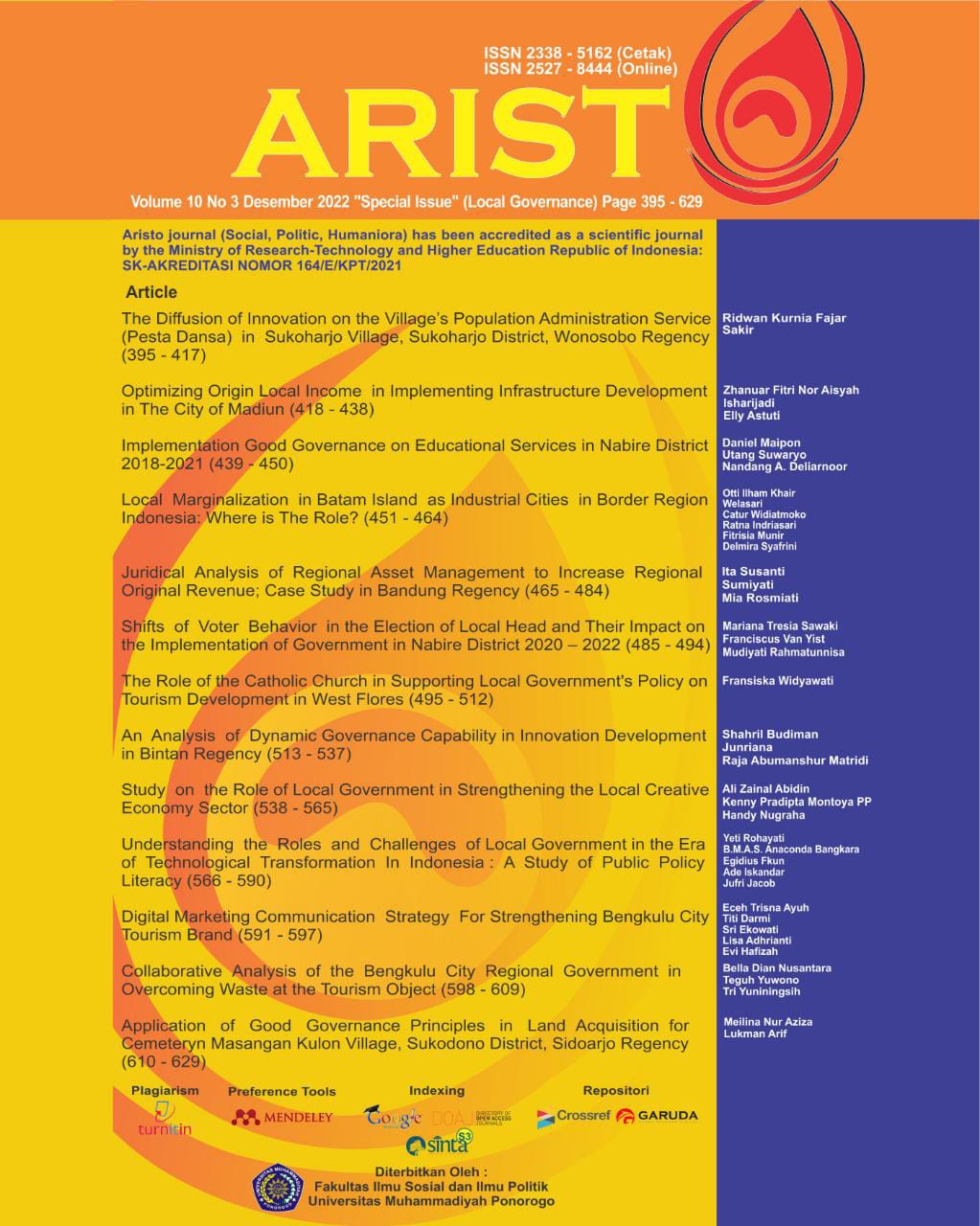
Understanding the Roles and Challenges of Local Government in the Era of Technological Transformation in Indonesia: A Study of Public Policy Literacy
DOI:
https://doi.org/10.24269/ars.v10i3.6303Abstract
This study is aimed to understand the challenges of the Indonesia’s local governments in the era where technology has transformed the public service system from a manual method to an all-digital application method. A series of efforts are made to discuss and find the solutions to the problem of the study. The data is searched electronically from literature sources including various publications such as journals, and other papers that are used as the data sources of this research. After a series of selection and searching for relevant data, the required data is finally collected. The data is examined through a phenomenological approach, referring to an effort in obtaining resilience from some existing data to get the answers for the discussed phenomenon, the challenges and roles of local government. The analysis process involves several techniques, including coding, verifying, evaluating, synthesizing, organizing, and carrying out in-depth interpretations that make it easier for the author to draw conclusions to answer the research problem with a good validity. The results of the data and discussion conclude that the challenges and roles given to the local governments in this reform era include the inconsistency of Bureaucratic Reform in the government and the challenges in adapting various dynamics such as pandemics and other crises, including the abuse of authority and indiscipline of the apparatus, especially the officials in carrying out their duties and functions as public servants. Thus, this research provides important results that complements and enlightens similar researches in the future.
Downloads
References
Akib, H., & Ihsan, A. (2017). Bureaucratic reform in public service: A case study on the one stop-integrated service. Mediterranean Journal of Social Sciences, 8(2), 253–253.
Anggraeni, D. (2014). The effect of policy implementation of bureaucracy reform and the organizational development to the public service quality in the ministry of home affairs. International Journal of Social Sciences, 24(1), 1–22.
Aris, S. (2018). Bureaucracy and disruption reform policy. Russian Journal of Agricultural and Socio-Economic Sciences, 81(9), Article 9.
Asyikin, N. (2020). Legal politics of bureaucratic reform in really good governance according to prophetical law. Legality: Jurnal Ilmiah Hukum, 28(1), 81–95.
Ayuningtyas, D., Haq, H. U., Utami, R. R. M., & Susilia, S. (2021). Requestioning the Indonesia Government’s Public Policy Response to the COVID-19 Pandemic: Black Box Analysis for the Period of January–July 2020. Frontiers in Public Health, 9. https://www.frontiersin.org/articles/10.3389/fpubh.2021.612994
Aziz, F. N., & Roziqin, A. (2020). The Perspective of Bureaucratic Reform (Kang Yoto’s Leadership) in Bojonegoro. JAKPP (Jurnal Analisis Kebijakan & Pelayanan Publik), 126–142. https://doi.org/10.31947/jakpp.vi.10014
Azzahra, N. F. (2020). Mengkaji hambatan pembelajaran jarak jauh di Indonesia di masa pandemi covid-19.
Bandaragoda, D. J. (2000). A Framework for Institutional Analysis for Water Resources Management in a River Basin Context. IWMI.
Boland-DeVito, J. (2019). Fashion(ing) a Political Statement: A Review of the Legal & Social Issues That Arise from Banned Political Clothing and Other Controversial Fashion Items in Light of the U.S. Supreme Court’s Decision in Minnesota Voters Alliance v. Mansky. Fordham Intellectual Property, Media & Entertainment Law Journal, 30, 493.
Braun, W., Auerbach, J., Chou, J., Teng, J., & Tu, P. (2020). Decisiones de polÃtica y uso de la tecnologÃa de la información para combatir la enfermedad por coronavirus, Taiwán. Emerg Infect Dis, 26(7), 1506–1512.
Brierley, S. (2020). Unprincipled Principals: Co-opted Bureaucrats and Corruption in Ghana. American Journal of Political Science, 64(2), 209–222. https://doi.org/10.1111/ajps.12495
Campbell, J. R., Uppal, A., Oxlade, O., Fregonese, F., Bastos, M. L., Lan, Z., Law, S., Oh, C. E., Russell, W. A., Sulis, G., Winters, N., Yanes-Lane, M., Brisson, M., Laszlo, S., Evans, T. G., & Menzies, D. (2020). Active testing of groups at increased risk of acquiring SARS-CoV-2 in Canada: Costs and human resource needs. CMAJ, 192(40), E1146–E1155. https://doi.org/10.1503/cmaj.201128
Chandrasekaran, R., Mehta, V., Valkunde, T., & Moustakas, E. (2020). Topics, Trends, and Sentiments of Tweets About the COVID-19 Pandemic: Temporal Infoveillance Study. Journal of Medical Internet Research, 22(10), e22624. https://doi.org/10.2196/22624
Chen, D., & Zhao, H. (2012). Data Security and Privacy Protection Issues in Cloud Computing. 2012 International Conference on Computer Science and Electronics Engineering, 1, 647–651. https://doi.org/10.1109/ICCSEE.2012.193
Chen, M. H. (2019). How Much Procedure Is Needed for Agencies to Change" Novel" Regulatory Policies? Hastings LJ, 71, 1127.
Crozier, M., & Friedberg, E. (2017). The bureaucratic phenomenon. Routledge.
Darmi, T., & Suwitri, S. (2017). Strengthening the capacity of human resources apparatus in the implementation of new autonomous regions. European Journal of Social Sciences, 55(4), 427–438.
DeVries, M. (2010). Sustainable Youth Ministry: Why Most Youth Ministry Doesn’t Last and What Your Church Can Do About It. InterVarsity Press.
Dewi, N., Azam, S., & Yusoff, S. (2019). Factors influencing the information quality of local government financial statement and financial accountability. Management Science Letters, 9(9), 1373–1384.
Diprose, R., McRae, D., & Hadiz, V. R. (2019). Two Decades of Reformasi in Indonesia: Its Illiberal Turn. Journal of Contemporary Asia, 49(5), 691–712. https://doi.org/10.1080/00472336.2019.1637922
Djalante, R., Lassa, J., Setiamarga, D., Sudjatma, A., Indrawan, M., Haryanto, B., Mahfud, C., Sinapoy, M. S., Djalante, S., Rafliana, I., Gunawan, L. A., Surtiari, G. A. K., & Warsilah, H. (2020). Review and analysis of current responses to COVID-19 in Indonesia: Period of January to March 2020. Progress in Disaster Science, 6, 100091. https://doi.org/10.1016/j.pdisas.2020.100091
Friyani, R., Herawaty, N., & Yuliana, Y. (2020). Brown Analysis Model for Measuring the Performance of Local Governments with Related to Budget Management Jambi City Government Revenue and Expenditure Year 2016-2019 (No. 1; Vol. 1, Issue 1). Lembaga Penelitian dan Pengabdian Pada Masyarakat Uiversitas Jambi. https://repository.unja.ac.id/17149/
Gaus, N., Sultan, S., & Basri, M. (2017). State Bureaucracy in Indonesia and its Reforms: An Overview. International Journal of Public Administration, 40(8), 658–669. https://doi.org/10.1080/01900692.2016.1186179
Gertler, M. S. (2010). Rules of the Game: The Place of Institutions in Regional Economic Change. Regional Studies, 44(1), 1–15. https://doi.org/10.1080/00343400903389979
Giljević, T., & Lalić Novak, G. (2018). Coordination Instruments in Croatian Integration Policy: Classification, Evaluation, and Proposals for Improvements. Hrvatska i Komparativna Javna Uprava : Časopis Za Teoriju i Praksu Javne Uprave, 18(3), 373–396. https://doi.org/10.31297/hkju.18.3.1
Henderson, C., Beach, A., & Finkelstein, N. (2011). Facilitating change in undergraduate STEM instructional practices: An analytic review of the literature. Journal of Research in Science Teaching, 48(8), 952–984.
Hilton, M. (2018). Oxfam and the Problem of NGO Aid Appraisal in the 1960s. Humanity: An International Journal of Human Rights, Humanitarianism, and Development, 9(1), 1–18. https://doi.org/10.1353/hum.2018.0000
Indriyati, I., Suryono, A., Pratiwi, R. N., & Amin, F. (2020). The Development of Regional Working Unit Structuring Model in the East Nusa Tenggara Provincial Government. Wacana Journal of Social and Humanity Studies, 23(4), Article 4. https://wacana.ub.ac.id/index.php/wacana/article/view/866
Ioannidis, J. P. A., Greenland, S., Hlatky, M. A., Khoury, M. J., Macleod, M. R., Moher, D., Schulz, K. F., & Tibshirani, R. (2014). Increasing value and reducing waste in research design, conduct, and analysis. The Lancet, 383(9912), 166–175. https://doi.org/10.1016/S0140-6736(13)62227-8
Kadarisman, M., Wijayanto, A. W., & Sakti, A. D. (2022). Government Agencies’ Readiness Evaluation towards Industry 4.0 and Society 5.0 in Indonesia. Social Sciences, 11(8), Article 8. https://doi.org/10.3390/socsci11080331
Kaewunruen, S., Sussman, J. M., & Matsumoto, A. (2016). Grand Challenges in Transportation and Transit Systems. Frontiers in Built Environment, 2. https://www.frontiersin.org/articles/10.3389/fbuil.2016.00004
Kamal, M., Weerakkody, V., & Irani, Z. (2011). Analyzing the role of stakeholders in the adoption of technology integration solutions in UK local government: An exploratory study. Government Information Quarterly, 28(2), 200–210. https://doi.org/10.1016/j.giq.2010.08.003
Kaur, M. J., Mishra, V. P., & Maheshwari, P. (2020). The Convergence of Digital Twin, IoT, and Machine Learning: Transforming Data into Action. In M. Farsi, A. Daneshkhah, A. Hosseinian-Far, & H. Jahankhani (Eds.), Digital Twin Technologies and Smart Cities (pp. 3–17). Springer International Publishing. https://doi.org/10.1007/978-3-030-18732-3_1
Kettl, D. F. (2016). Politics of the Administrative Process. CQ Press.
Kim, G.-H., Trimi, S., & Chung, J.-H. (2014). Big-data applications in the government sector. Communications of the ACM, 57(3), 78–85. https://doi.org/10.1145/2500873
King, C. S., Feltey, K. M., & Susel, B. O. (2015). The question of participation: Toward authentic public participation in public administration. In The age of direct citizen participation (pp. 391–408). Routledge.
Kosandi, M., & Wahono, S. (2020). Military Reform in the Post-New Order Indonesia: A Transitional or a New Subtle Role in Indonesian Democracy? Asian Politics & Policy, 12(2), 224–241. https://doi.org/10.1111/aspp.12534
Labolo, M., & Indrayani, E. (2017). Bureaucratic Reform and the Challenge of Good Governance Implementation in Indonesia. Journal Of Asian Review Of Public Affair And Policy, 2(4), Article 4.
Leuwol, N. V., Wula, P., Purba, B., Marzuki, I., Brata, D. P. N., Efendi, M. Y., Masrul, M., Sahri, S., Ahdiyat, M., Sari, I. N., Gusty, S., Nugraha, N. A., Bungin, E. R., Purba, B., & Anwar, A. F. (2020). Pengembangan Sumber Daya Manusia Perguruan Tinggi: Sebuah Konsep, Fakta dan Gagasan. Yayasan Kita Menulis.
Lips, M. (2019). Digital Government: Managing Public Sector Reform in the Digital Era. Routledge.
Mackey, T. K., & Nayyar, G. (2017). A review of existing and emerging digital technologies to combat the global trade in fake medicines. Expert Opinion on Drug Safety, 16(5), 587–602. https://doi.org/10.1080/14740338.2017.1313227
Mergel, I., & Desouza, K. C. (2013). Implementing Open Innovation in the Public Sector: The Case of Challenge.gov. Public Administration Review, 73(6), 882–890. https://doi.org/10.1111/puar.12141
Moonti, R. M. (2019). Regional Autonomy in Realizing Good Governance. Substantive Justice International Journal of Law, 2(1), Article 1. https://doi.org/10.33096/substantivejustice.v2i1.31
Munawaroh, N. (2018). MEWUJUDKAN GOOD GOVERNANCE MELALUI REFORMASI BIROKRASI:(Kasus Pelayanan Pembuatan E-Kartu Tanda Penduduk (E-KTP) di Dinas Kependudukan dan Catatan Sipil Kabupaten Bandung Provinsi Jawa Barat). Jurnal Dukcapil (Kependudukan Dan Catatan Sipil), 21–46.
Nagy, J., Oláh, J., Erdei, E., Máté, D., & Popp, J. (2018). The Role and Impact of Industry 4.0 and the Internet of Things on the Business Strategy of the Value Chain—The Case of Hungary. Sustainability, 10(10), Article 10. https://doi.org/10.3390/su10103491
Nankervis, A., Baird, M., Coffey, D. J., & Shields, J. (2019). Human Resource Management. Cengage AU.
Napir, S., & Junus, D. (2019). Penguatan Program Prioritas Pemerintah Daerah Dalam Mewujudkan Good Governance Di Kabupaten Gorontalo. Journal of Public Administration and Government, 1(1), 34–38.
Ncamphalala, M. (2019). The role of ICT to promote smart governance in local governments [PhD Thesis]. University of Johannesburg Johannesburg.
Nugroho, R. (2020). KAJIAN ANALISIS MODEL E-READINESS DALAM RANGKA IMPLEMENTASI E-GOVERNMENT STUDY ANALYSIS OF E-READINESS MODEL IN THE IMPLEMENTATION OF E-GOVERNMENT. In Masyarakat Telematika Dan Informasi: Jurnal Penelitian Teknologi Informasi dan Komunikasi (Vol. 11). https://doi.org/10.17933/mti.v11i1.171
Pearson, S., & Benameur, A. (2010). Privacy, Security and Trust Issues Arising from Cloud Computing. 2010 IEEE Second International Conference on Cloud Computing Technology and Science, 693–702. https://doi.org/10.1109/CloudCom.2010.66
Qasem, Y. A. M., Asadi, S., Abdullah, R., Yah, Y., Atan, R., Al-Sharafi, M. A., & Yassin, A. A. (2020). A Multi-Analytical Approach to Predict the Determinants of Cloud Computing Adoption in Higher Education Institutions. Applied Sciences, 10(14), Article 14. https://doi.org/10.3390/app10144905
Rahmadana, M. F., Mawati, A. T., Siagian, N., Perangin-angin, M. A., Refelino, J., Tojiri, M. Y., Siagian, V., Nugraha, N. A., Manullang, S. O., Silalahi, M., Yendrianof, D., Sari, A. P., Supriadi, M. N., Sari, M. H. N., & Bahri, S. (2020). Pelayanan Publik. Yayasan Kita Menulis.
RamÃrez de la Cruz, E. E., Grin, E. J., Sanabria-Pulido, P., Cravacuore, D., & Orellana, A. (2020). The Transaction Costs of Government Responses to the COVID-19 Emergency in Latin America. Public Administration Review, 80(4), 683–695. https://doi.org/10.1111/puar.13259
Saggaf, S., Said, M. M., & Saggaf, W. S. (2018). Reformasi Pelayanan Publik di Negara Berkembang. SAH MEDIA.
Saluy, A. B., Prawira, B., & Buntaran, D. F. A. A. (2019). The Influence of Leadership, Working Culture, and Working Environment for the Ministry of Administrative Reform and Bureaucracy. International Journal of Business and Economic Affairs, 4(5), Article 5.
Sitokdana, M. N. N. (2019). Evaluation of the Information Quality of E-Government Websites of the Provincial Governments of Eastern Indonesia (Case Study: NTT Province, Maluku, North Maluku, West Papua and Papua). 2019 International Conference on Organizational Innovation (ICOI 2019), 231–241.
Spiegel, S. J. (2012). Governance Institutions, Resource Rights Regimes, and the Informal Mining Sector: Regulatory Complexities in Indonesia. World Development, 40(1), 189–205. https://doi.org/10.1016/j.worlddev.2011.05.015
Sun, P.-L., Ku, C.-Y., & Shih, D.-H. (2015). An implementation framework for E-Government 2.0. Telematics and Informatics, 32(3), 504–520. https://doi.org/10.1016/j.tele.2014.12.003
Tome, A. H. (2012). Reformasi Birokrasi Dalam Rangka Mewujudkan Good Governance Ditinjau Dari Peraturan Menteri Pemberdayaan Aparatur Negara dan Reformasi Birokrasi Nomor 20 Tahun 2010. Jurnal Hukum Unsrat, 20(3), 132–147.
Turner, M., Prasojo, E., & Sumarwono, R. (2022). The challenge of reforming big bureaucracy in Indonesia. Policy Studies, 43(2), 333–351. https://doi.org/10.1080/01442872.2019.1708301
Umar, A., Madani, M., Farida, U., Yusriadi, Y., Tamsa, H., Yahya, M., Alam, S., Gunawan, H., Sahabuddin, C., & Akbar, Z. (2019). One-stop service policy as a bureaucratic reform in indonesia. Academy of Strategic Management Journal, 18(2), 1–12.
Vanebo, J. O., & Murdock, A. (2012). Innovation and Creative Leadership in Local Government. Foundations of the Knowledge Economy. https://www.elgaronline.com/view/edcoll/9780857937711/9780857937711.00014.xml
Volden, G. H., & Andersen, B. (2018). The hierarchy of public project governance frameworks: An empirical study of principles and practices in Norwegian ministries and agencies. International Journal of Managing Projects in Business, 11(1), 174–197. https://doi.org/10.1108/IJMPB-04-2017-0040
Weber, R. H., & Studer, E. (2016). Cybersecurity in the Internet of Things: Legal aspects. Computer Law & Security Review, 32(5), 715–728. https://doi.org/10.1016/j.clsr.2016.07.002
Wihantoro, Y., Lowe, A., Cooper, S., & Manochin, M. (2015). Bureaucratic reform in post-Asian Crisis Indonesia: The Directorate General of Tax. Critical Perspectives on Accounting, 31, 44–63. https://doi.org/10.1016/j.cpa.2015.04.002
Xue, L., & Liou, K. T. (2012). Government Reform in China: Concepts and Reform Cases. Review of Public Personnel Administration, 32(2), 115–133. https://doi.org/10.1177/0734371X12438242
Downloads
Published
Issue
Section
License
Authors Who Publish whit this journal agree to the following term :
Copyright on any article is retained by the Journal
- Author grant the journal right of first publication with the work simultaneously licensed under a Creative Commons Attribution License that allows others to share the work with an acknowledgement of the work's authorship and initial publication in this;
- Authors are able to enter into separate, additional contractual arrangements for the non-exclusive distribution of the journal's published version of the work (e.g., post it to an institutional repository or publish it in a book), with an acknowledgement of its initial publication in this journal;
- Authors are permitted and encouraged to post their work online (e.g., in institutional repositories or on their website) prior to and during the submission process, as it can lead to productive exchanges, as well as earlier and greater citation of published work;
- Every accepted manuscript should be accompanied by Copyright Transfer Agreement (CTA), prior to the article publication. CTA can be downloaded here;
=====================================================================================================
Penulis yang mempublikasikan naskahnya pada Jurnal ini menyetujui ketentuan berikut:
Hak cipta pada setiap artikel adalah milik jurnal.
- Penulis mengakui bahwa Jurnal ARISTO berhak sebagai mempublikasikan pertama kali dengan bekerja secara bersamaan dibawah Creative Commons Attribution License yang memungkinkan orang lain untuk membagi pekerjaan dengan pengakuan dari pengarang dan publikasi pertama dalam jurnal ARISTO;
- Penulis dapat memasukan tulisan secara terpisah, mengatur distribusi non-ekskulif  dari naskah yang telah terbit di jurnal ini kedalam versi yang lain (misal: dikirim ke respository institusi penulis, publikasi kedalam buku, dll), dengan mengakui bahwa naskah telah terbit pertamakali pada Jurnal ARISTO;
- Penulis diperbolehkan dan didorong untuk mengirimkan pekerjaan mereka secara daring (misal melalui respositories atau website instansi penulis) sebelum atau selama proses pengiriman pada Jurnal ARISTO berlangsung, ini dapat menjadikan pertukaran informasi yang sangat produktif, dan serta menjadikan kutipan yang banyak dari publikasi;
- Setiap naskah yang diterima wajib menyertakan Perjanjian Pemindahan Hakcipta (Copyright Transfer Agreement/CTA), sebelum artikel diterbitkan. CTA dapat diunduh di sini


