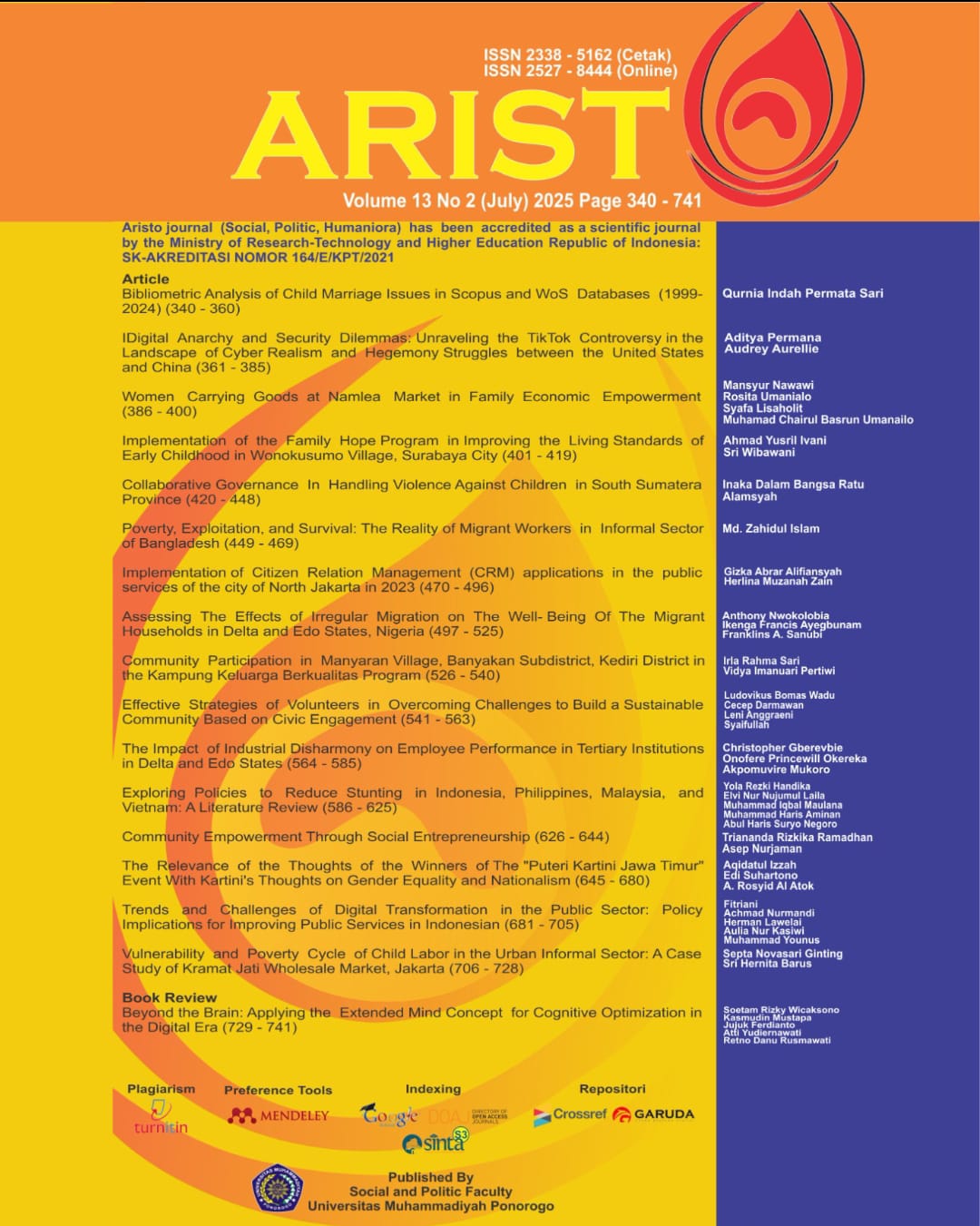
Vulnerability and Poverty Cycle of Child Labor in the Urban Informal Sector: A Case Study of Kramat Jati Wholesale Market, Jakarta
DOI:
https://doi.org/10.24269/ars.v13i2.11527Abstract
The phenomenon of child labor, especially for women in the urban informal sector, is still a complex social problem in Indonesia. This study aims to analyze the factors that encourage girls to work in the informal sector, the impact of work on their welfare, and the effectiveness of government policies in addressing this problem. Using a qualitative approach and case study method at the Kramat Jati Wholesale Market, Jakarta, this study collected data through field observations, in-depth interviews with girl workers and their families, and policy analysis related to child labor in Indonesia. The study results indicate that family poverty, lack of access to education, and social norms normalizing child labor are the main factors that encourage them to work. These girl workers are socially excluded in various forms. The lack of inclusive education services for children of workers is intertwined with them losing access to other rights such as poor health conditions, lack of safe places, vulnerable families due to crime and  unregistered marriages, dropping out of school, and ending child marriage. Educational inequality perpetuates child labor and creates a cycle of poverty that is passed down to the next generation.
Downloads
References
Anshor, M.U. (2016). Kerentanan Perempuan dalam Pernikahan Anak. Jurnal Perempuan, volume 21 No.1, halaman 59-65.
Bahy, W. N., Prabandari, A. P., & Wibawa, K. C. S. (2024). The Impact of ILO Convention No. 182 (1999) on Safeguarding Against Child Labor in Indonesia. International Journal Of Multidisciplinary Research And Analysis, 07(04). 1472-1477
ILO (2011). Causes. Dalam https://www.ilo.org/resource/causes diakses 20 November 2024
ILO, 2000, Child labour and domestic work dalam https://www.ilo.org/resource/conference-paper/review-annual-reports-under-follow-ilo-declaration-fundamental-principles-0
Jaggar, A. M. (2009). Transnational Cycles of Gendered Vulnerability: A Prologue to a Theory of Global Gender Justice. Philosophical Topics, 37(2), 33–52. http://www.jstor.org/stable/43154555
Jarjoura, G. R., Triplett, R. A., & Brinker, G. P. (2002). Growing up poor: Examining the link between persistent childhood poverty and delinquency. Journal of Quantitative Criminology, 18, 159-187.
Kemenkes, (2018), Kenali Masalah Gizi yang Ancam Remaja Indonesia dalam https://sehatnegeriku.kemkes.go.id/baca/rilis-media/20180515/4025903/kenali-masalah-gizi-ancam-remaja-indonesia/#:~:text=Remaja%20Kurang%20Zat%20Besi%20 diakses pada 12 Desember 2024
Marumu, M. N. H. D., & Peuru, C. D. (2022). Pengaruh Jumlah Penduduk dan Pengangguran Terhadap Tingkat Kemiskinan di Kabupaten Tolitoli. Growth: Jurnal Ilmiah Ekonomi Pembangunan, 4(1), 19-26.
Maulana, A., & Suryaningrum, N. Pengaruh Kemiskinan Terhadap Pekerja Anak Indonesia: Analisis Data Mikro. Jurnal dinamika ekonomi pembangunan, 5(3), 258-269.
Muflih, A., & Rafii, M. Pekerja Anak di Kawasan Timur Indonesia Tahun 2022: Kondisi dan Faktor yang Memengaruhi. Jurnal Ekonomi Kependudukan dan Keluarga, 1(2), 6.
Pamuji, W. S. (2016). Status of Child and Woman in Unregistered Marriage: A Study of Family Resilience and Human Security. Jurnal Perempuan, 21(1), 49-58.
Saptandari, P. (2016). Pembangunan Ketahanan Keluarga Sebagai Upaya Pencegahan Perkawinan Anak. Jurnal Perempuan untuk Pencerahan dan Kesetaraan. Vol. 21 No, 1.
Simangunsong, A. N., Nelly.P., &Nike.K.R. (2023). Kebijakan Negara Dalam Rangka Pengurangan Pekerja Anak Menurut Perspektif Hak Asasi Manusia Di Indonesia. LEX CRIMEN, 12(1).
Susanto, R., & Pangesti, I. (2020). Pengaruh inflasi dan pertumbuhan ekonomi terhadap tingkat kemiskinan di Indonesia. JABE (Journal of Applied Business and Economic), 7(2), 271-278.
TribunNews. (2019). Impian Tak Terbeli Bocah Kuli Pungut Pasar Induk Kramat Jati: Punya Sepeda dan Jam Tangan HP dalam https://www.tribunnews.com/metropolitan/2019/07/26/impian-tak-terbeli-bocah-kuli-pungut-pasar-induk-kramat-jati-punya-sepeda-dan-jam-tangan-hp. diakses Juni 2024
Downloads
Published
Issue
Section
License
Authors Who Publish whit this journal agree to the following term :
Copyright on any article is retained by the Journal
- Author grant the journal right of first publication with the work simultaneously licensed under a Creative Commons Attribution License that allows others to share the work with an acknowledgement of the work's authorship and initial publication in this;
- Authors are able to enter into separate, additional contractual arrangements for the non-exclusive distribution of the journal's published version of the work (e.g., post it to an institutional repository or publish it in a book), with an acknowledgement of its initial publication in this journal;
- Authors are permitted and encouraged to post their work online (e.g., in institutional repositories or on their website) prior to and during the submission process, as it can lead to productive exchanges, as well as earlier and greater citation of published work;
- Every accepted manuscript should be accompanied by Copyright Transfer Agreement (CTA), prior to the article publication. CTA can be downloaded here;
=====================================================================================================
Penulis yang mempublikasikan naskahnya pada Jurnal ini menyetujui ketentuan berikut:
Hak cipta pada setiap artikel adalah milik jurnal.
- Penulis mengakui bahwa Jurnal ARISTO berhak sebagai mempublikasikan pertama kali dengan bekerja secara bersamaan dibawah Creative Commons Attribution License yang memungkinkan orang lain untuk membagi pekerjaan dengan pengakuan dari pengarang dan publikasi pertama dalam jurnal ARISTO;
- Penulis dapat memasukan tulisan secara terpisah, mengatur distribusi non-ekskulif  dari naskah yang telah terbit di jurnal ini kedalam versi yang lain (misal: dikirim ke respository institusi penulis, publikasi kedalam buku, dll), dengan mengakui bahwa naskah telah terbit pertamakali pada Jurnal ARISTO;
- Penulis diperbolehkan dan didorong untuk mengirimkan pekerjaan mereka secara daring (misal melalui respositories atau website instansi penulis) sebelum atau selama proses pengiriman pada Jurnal ARISTO berlangsung, ini dapat menjadikan pertukaran informasi yang sangat produktif, dan serta menjadikan kutipan yang banyak dari publikasi;
- Setiap naskah yang diterima wajib menyertakan Perjanjian Pemindahan Hakcipta (Copyright Transfer Agreement/CTA), sebelum artikel diterbitkan. CTA dapat diunduh di sini


