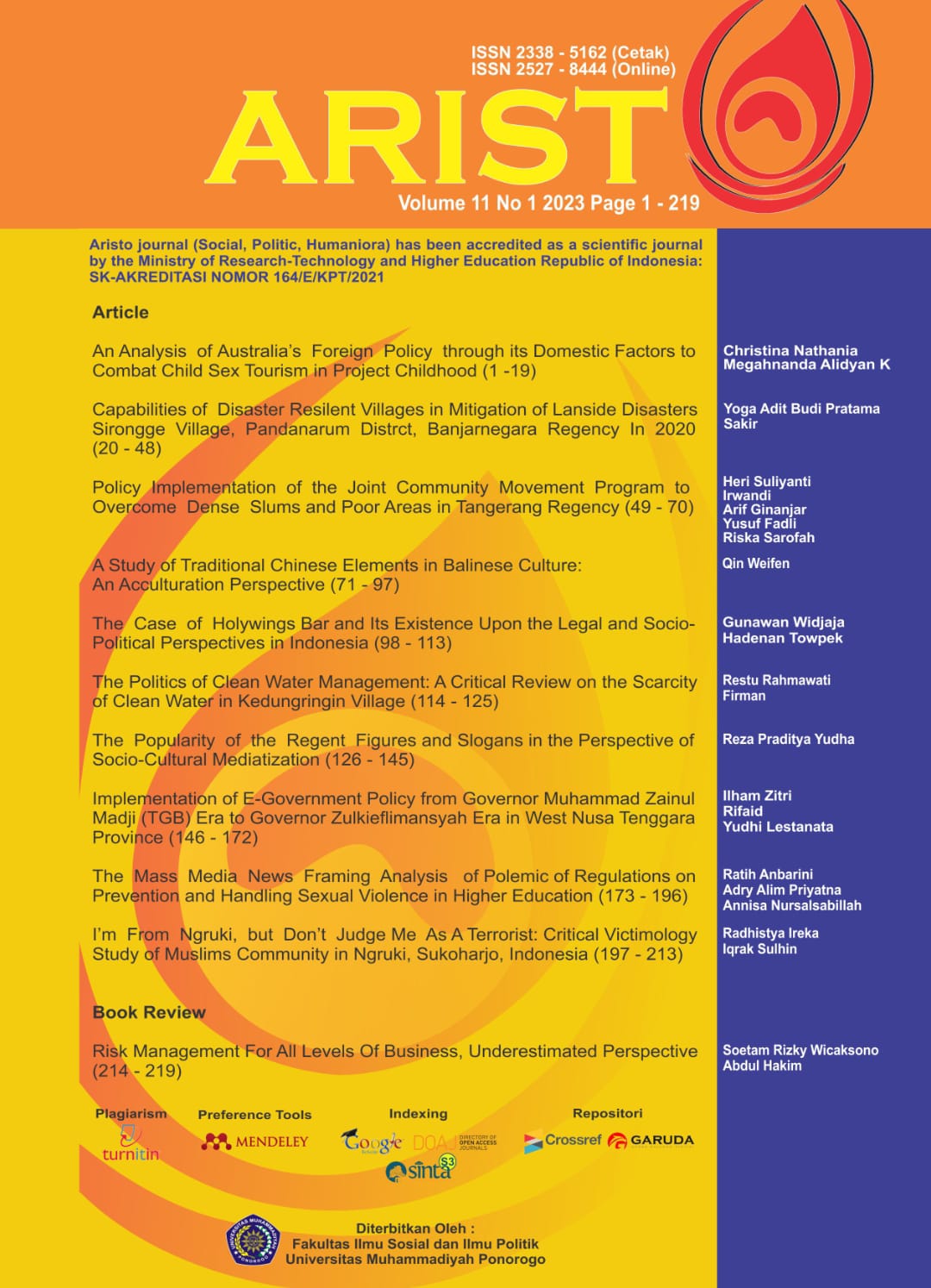
The Politics of Clean Water Management: A Critical Review on the Scarcity of Clean Water in Kedungringin Village
DOI:
https://doi.org/10.24269/ars.v11i1.5247Abstract
This paper will examine the politics of clean water management, a review on the scarcity of clean water quality in Kedungringin Village, Sukawangi District, Bekasi Regency. This study is conducted due to a problem occurred in Kedungringin Village regarding the lack of access to clean water both in quality and quantity. Various efforts have been taken by the villagers of Kedungringin, such as constructing boreholes with the help of benefactors. However, this is insufficient to meet the needs of clean water for all residents. In this case, the role of PDAM Tirta Bhagasasi is limited as not being able to reach the Kedungringin Village area due to the far distance of Clean Water Pipeline from the location of Kedungringin Village. By these problems, this study will examine the efforts taken by PDAM Tirta Bhagasasi and the authority of Sukaringin Village in fulfilling the need of clean water access in Kedungringin Village. The research method used in this study is a descriptive qualitative research method with a case study approach. The results of this study indicate that the efforts taken by PDAM Tirta Bhagasasi in fulfilling the need of clean water for the villagers in Kedungringin have not been realized yet. This is for the reason thatin constructing a new clean water pipeline, PDAM Tirta Bhagasasi only reaches the housing/cluster area in Sukaringin Village. Hence, the clean water isunable to flow to Kedungringin Village since PDAM Tirta Bhagasasi prioritizes the cluster housing areas by collaborating with developers. This means that the well-financed community will be prioritized over the low-financed community.
Downloads
References
Dr. Drs. Imail Nurdin, M. (2019). Metode Penelitian Sosial. In M. Dr. Drs. Imail Nurdin, Metode Penelitian Sosial (p. 36). Surabaya, Jawa Timur, Indonesia: Media Sahabat Cendekia.
Eko NurSurachman, S. W. (2022). Stakeholder management mapping to improve public-private partnership success in emerging country water projects: Indonesia’s experience. Utilities Policy, 1-12.
Eloise M.Biggs, J. M. (2013). Plenty of water, not enough strategy: How inadequate accessibility, poor governance and a volatile government can tip the balance against ensuring water security: The case of Nepal. Environmental Science & Policy, 388-394.
Endaryanta, E. (2007). Politik air di Indonesia : penjarahan Si Gedhang oleh korporasi Aqua-Danone. Yogyakarta: Laboratorium Jurusan Ilmu Pemerintahan FISIP Universitas Gadjah Mada.
Firman, R. R. (2017). Analisis Impelementasi Kebijakan Aplikasi Qlue Di Wilayah Jakarta Utara Restu. ARISTO, 386-404.
Geoff Goodwin, P. O. (2022). The politics of coproduction during Latin America’s ‘Pink Tide’: Water, housing, and waste in comparative perspective. World Development, 1-14.
Kathleen Kevany, D. H. (2013). A review of progress in empowerment of women in rural water management decision-making processes. Journal of Cleaner Production, 53-64.
Leite, M. C. (2022). A comparison of Brazilian, North American, and English water supply regulation models. Groundwater for Sustainable Development, 1-13.
Michael Hellwiga, A. P. (2021). Do political links influence water prices? Determinants of water prices. Utilities Policy, 1-13.
Millington, N. (2018). Producing water scarcity in São Paulo, Brazil: The 2014-2015 water crisis and the binding politics of infrastructure. Political Geography, 26-34.
Moleong, L. J. (2014). Metodologi Penelitian Kualitatif [Edisi Revisi]. Jakarta: Remaja Rosdakarya E.
Morris, J. C. (2022). Clean Water Policy and State Choice Promise and Performance in The Water Quality Act. United Kingdom: Cambridge University Press.
Mustafa, D. (2016). Water User Associations and the Politics of Water in Jordan. World Development, 164-176.
PekkaLeviäkangas. (2021). Addressing sustainability or following political climate Rhetoric? Anatomy of government Agency’s performance management. Case Studies on Transport Policy, 191-199.
Qinhong Xu, R. B. (2022). Rural drinking water governance politics in China: Governmentality. Political Geography, 1-10.
Rahmawati, R. (2017). Analisis Impelementasi Kebijakan Aplikasi Qlue Di Wilayah Jakarta Utara. ARISTO, 386-404.
Richa Saxenaa, N. S. (2022). The role of government in urban water management. Current Directions in Water Scarcity Research, 341-359.
Sehring, J. (2009). Comparing the Politics of Water Institutional Reform. In: The Politics of Water Institutional Reform in Neopatrimonial States. German: VS Verlag für Sozialwissenschaften.
sihotang, j. (2018). Penuhi Cakupan Air Bersih, PDAM Lakukan Kerjasama Pihak Ketiga. Retrieved from tirtabhagasasi.co.id: https://tirtabhagasasi.co.id/penuhi-cakupan-air-bersih-pdam-lakukan-kerjasama-pihak-ketiga/
Sugiyono. (2018). Metode Penelitian Kuantitatif, Kualitatif. Bandung: Alfabeta.
Suryati. (2022, Januari Sunday). Interview With Interviewee. (R. Rahmawati, Interviewer)
Teresa Cristina TarléPissarra, L. F. (2021). Production of clean water in agriculture headwater catchments: A model based on the payment for environmental services. Science of The Total Environment, 1-12.
Yuksel, I. (2015). Water management for sustainable and clean energy in Turkey. Energy Reports, 129-133.
Downloads
Published
Issue
Section
License
Authors Who Publish whit this journal agree to the following term :
Copyright on any article is retained by the Journal
- Author grant the journal right of first publication with the work simultaneously licensed under a Creative Commons Attribution License that allows others to share the work with an acknowledgement of the work's authorship and initial publication in this;
- Authors are able to enter into separate, additional contractual arrangements for the non-exclusive distribution of the journal's published version of the work (e.g., post it to an institutional repository or publish it in a book), with an acknowledgement of its initial publication in this journal;
- Authors are permitted and encouraged to post their work online (e.g., in institutional repositories or on their website) prior to and during the submission process, as it can lead to productive exchanges, as well as earlier and greater citation of published work;
- Every accepted manuscript should be accompanied by Copyright Transfer Agreement (CTA), prior to the article publication. CTA can be downloaded here;
=====================================================================================================
Penulis yang mempublikasikan naskahnya pada Jurnal ini menyetujui ketentuan berikut:
Hak cipta pada setiap artikel adalah milik jurnal.
- Penulis mengakui bahwa Jurnal ARISTO berhak sebagai mempublikasikan pertama kali dengan bekerja secara bersamaan dibawah Creative Commons Attribution License yang memungkinkan orang lain untuk membagi pekerjaan dengan pengakuan dari pengarang dan publikasi pertama dalam jurnal ARISTO;
- Penulis dapat memasukan tulisan secara terpisah, mengatur distribusi non-ekskulif  dari naskah yang telah terbit di jurnal ini kedalam versi yang lain (misal: dikirim ke respository institusi penulis, publikasi kedalam buku, dll), dengan mengakui bahwa naskah telah terbit pertamakali pada Jurnal ARISTO;
- Penulis diperbolehkan dan didorong untuk mengirimkan pekerjaan mereka secara daring (misal melalui respositories atau website instansi penulis) sebelum atau selama proses pengiriman pada Jurnal ARISTO berlangsung, ini dapat menjadikan pertukaran informasi yang sangat produktif, dan serta menjadikan kutipan yang banyak dari publikasi;
- Setiap naskah yang diterima wajib menyertakan Perjanjian Pemindahan Hakcipta (Copyright Transfer Agreement/CTA), sebelum artikel diterbitkan. CTA dapat diunduh di sini


