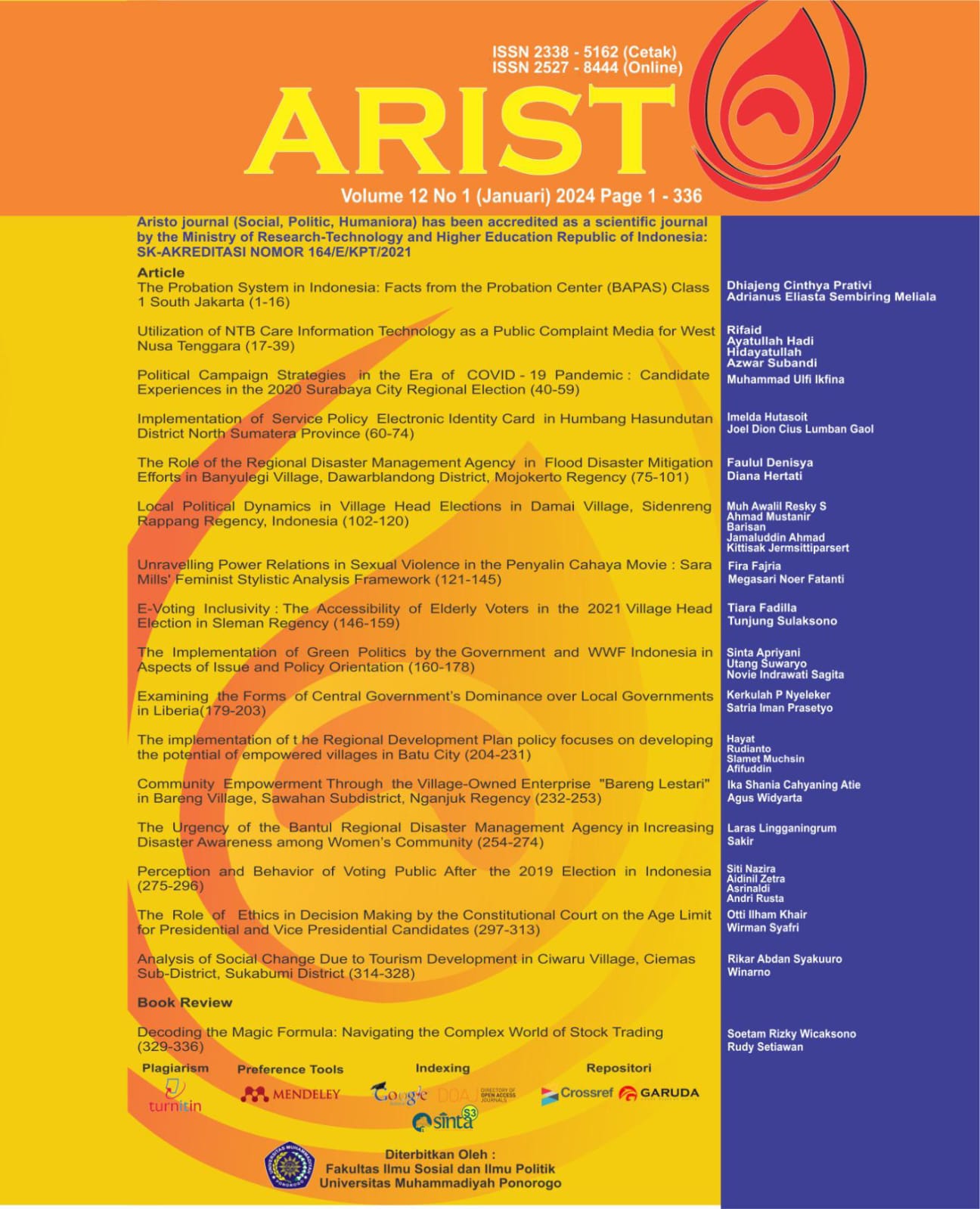
Utilization of NTB Care Information Technology as a Public Complaint Media for West Nusa Tenggara
DOI:
https://doi.org/10.24269/ars.v12i1.6078Abstract
This article tries to explain the use of information technology for the NTB Care application as a digital media for responding to public complaints. Three dimensions are measured to determine the effective implementation of NTB Care in resolving public complaint services: the Ease of Use dimension, the Trust dimension and the Reliability dimension. The research uses a comparative descriptive method with a qualitative approach and literature analysis by collecting data from official NTB government documents, the NTB Care data center, the NTB Care Website, the NTB care Facebook, and other literature related to NTB Care. The results showed that the use of the NTB Care application as a medium for responding to public complaints was good and received excellent public trust, but the obstacles faced were in the agency that became the goal of the problems raised by the community, the average response time for OPD in handling complaints that come in 1-120 days. There is no clarity regarding reports that have not been followed up on to be resolved. NTB Care is an application as a forum to accommodate the community's aspirations; then, the NTB Care admin will forward public complaints to the relevant agency or OPD based on the complaint problem who entered NTB Care.Downloads
Download data is not yet available.
References
Adeleye, N., & Eboagu, C. (2019). Evaluation of ICT development and economic growth in Africa. Netnomics, 20, 31–53. https://doi.org/10.1007/s11066-019-09131-6
Ahn, M. J., & Bretschneider, S. (2011). Politics of E-Government: E-Government and the Political Control of Bureaucracy. Public Administration Review, 71(3), 414–424. https://doi.org/10.1111/j.1540-6210.2011.02225.x
Amy, N., Muchali, A., Budiarto, J., Maulachela, A. B., & Ashril Rizal, A. (2020). Management of issue and public trust using information technology. Journal of Physics: Conference Series. https://doi.org/10.1088/1742-6596/1539/1/012073
Arduini, D., Belotti, F., Denni, M., Giungato, G., & Zanfei, A. (2010). Technology adoption and innovation in public services the case of e-government in Italy. Information Economics and Policy, 22(3), 257–275. https://doi.org/10.1016/j.infoecopol.2009.12.007
Atthahara, H. (2018). Inovasi Pelayanan Publik Berbasis E-Government : Studi Kasus Aplikasi Ogan Lopian Dinas. Jurnal Politikom Indonesia, 3(1), 66–77.
Baharuddin, T., Jubba, H., Nurmandi, A., & Qodir, Z. (2022). Online Social Trust in Government: Analysis of Government Policy During the Covid-19 Pandemic. Proceedings of the First International Conference on Democracy and Social Transformation, ICON-DEMOST 2021. EAI. https://doi.org/10.4108/eai.15-9-2021.2315575
Baharuddin, T., Qodir, Z., & Loilatu, M. J. (2022). Government Website Performance during Covid-19 : Comparative Study Yogyakarta and South Sulawesi , Indonesia. Journal of Governance and Public Policy, 9(2), 109–123. https://doi.org/10.18196/jgpp.v9i2.11474
Baharuddin, T., Sairin, S., Jubba, H., Qodir, Z., Nurmandi, A., & Hidayati, M. (2021). Social Capital and Social Trust : The State ’ s Response in Facing the Spread of COVID-19 in Indonesia. Sociology and Technoscience, 11(2), 23–47. https://doi.org/10.24197/st.2.2021.23-47
Eprilianto, D. F., Sari, Y. E. K., & Saputra, B. (2019). MEWUJUDKAN INTEGRASI DATA MELALUI IMPLEMENTASI INOVASI PELAYANAN KESEHATAN BERBASIS TEKNOLOGI DIGITAL. JPSI (Journal of Public Sector Innovations). https://doi.org/10.26740/jpsi.v4n1.p30-37
Fussey, P., & Roth, S. (2020). Digitizing Sociology: Continuity and Change in the Internet Era. Sociology, 54(4), 659–674. https://doi.org/10.1177/0038038520918562
Kurt, R. (2019). Industry 4.0 in Terms of Industrial Relations and Its Impacts on Labour Life. Procedia Computer Science, 158, 590–601. https://doi.org/10.1016/j.procs.2019.09.093
Lee-Geiller, S., & Lee, T. (David). (2019). Using government websites to enhance democratic E-governance: A conceptual model for evaluation. Government Information Quarterly, 36(2), 208–225. https://doi.org/10.1016/j.giq.2019.01.003
Mahmudah, D., & Nugroho, B. A. (2018). E-Complaining “siKesal†Implementation Analysis for Developing Electronic Based Public Services at Jambi City. Proceeding - 2018 International Conference on ICT for Rural Development: Rural Development through ICT: Concept, Design, and Implication, IC-ICTRuDEv 2018. https://doi.org/10.1109/ICICTR.2018.8706857
Mergel, I. (2019). Digital service teams in government. Government Information Quarterly, 36(4), 101389. https://doi.org/10.1016/j.giq.2019.07.001
Mestika Zed. (2008). Metode Penelitian Kepustakaan. Yayasan Obor Indonesia.
Morrar, R., & Arman, H. (2017). The Fourth Industrial Revolution (Industry 4.0): A Social Innovation Perspective. Technology Innovation Management Review. https://doi.org/10.22215/timreview/1117
Napitupulu, D. B. (2016). KUALITAS LAYANAN E-GOVERNMENT (SEBUAH ANALISA DI PEMKOT X DENGAN PENDEKATAN E-GOVQUAL DAN IPA). Jurnal Penelitian Pos Dan Informatika. https://doi.org/10.17933/jppi.2016.060203
Prabowo, T. L., & Irwansyah, I. (2018). Media Komunikasi Digital PolisiKu: Pelayanan Publik Polri kepada Masyarakat. Jurnal Studi Komunikasi (Indonesian Journal of Communications Studies). https://doi.org/10.25139/jsk.v2i3.1174
Ramadhani, R., Purnomo, E. P., & Kasiwi, A. N. (2020). E-Government Assessment pada Kualitias Aplikasi Jogja Smart Service (JSS) di Kota Yogyakarta. Jurnal Pemerintahan Dan Politik, 5(2), 58–62. https://doi.org/10.36982/jpg.v5i2.1031
Samih, H. (2019). Smart cities and internet of things. Journal of Information Technology Case and Application Research, 21(1), 3–12. https://doi.org/10.1080/15228053.2019.1587572
Santa, R., MacDonald, J. B., & Ferrer, M. (2019). The role of trust in e-Government effectiveness, operational effectiveness and user satisfaction: Lessons from Saudi Arabia in e-G2B. Government Information Quarterly, 36(1), 39–50. https://doi.org/10.1016/j.giq.2018.10.007
Sari, W. P. (2017). Analisis Penerapan E-Government dan Perubahan Interaksi Sosial setelah Mediatisasi di Desa Karang Bajo, Lombok. Jurnal The Messenger. https://doi.org/10.26623/themessenger.v9i2.457
Skop, E., & Li, W. (2005). Asians in America’s suburbs: Patterns and consequences of settlement. Geographical Review. https://doi.org/10.1111/j.1931-0846.2005.tb00361.x
Song, X., Cong, Y., Song, Y., Chen, Y., & Liang, P. (2020). Influences of the industry 4.0 revolution on the human capital development and consumer behavior: A systematic review. Sustainability, 12(10), 4035. https://doi.org/https://doi.org/10.3390/su12104035
Suaidah, S. (2021). Analisis Penerimaan Aplikasi Web Engineering Pelayanan Pengaduan Masyarakat Menggunakan Technology Acceptance Model. JATISI (Jurnal Teknik Informatika Dan Sistem Informasi). https://doi.org/10.35957/jatisi.v8i1.600
Weber, K. M., Heller-Schuh, B., Godoe, H., & Roeste, R. (2014). ICT-enabled system innovations in public services: Experiences from intelligent transport systems. Telecommunications Policy, 38(5–6), 539–557. https://doi.org/10.1016/j.telpol.2013.12.004
Widayat, R. M., Nurmandi, A., Rosilawati, Y., Natshir, H., Syamsurrijal, M., & Baharuddin, T. (2022). Bibliometric Analysis and Visualization Articles on Presidential Election in Social Media Indexed in Scopus by Indonesian Authors. Proceedings of the 1st World Conference on Social and Humanities Research (W-SHARE 2021). Atlantis Press. https://doi.org/10.2991/assehr.k.220402.032
Ahn, M. J., & Bretschneider, S. (2011). Politics of E-Government: E-Government and the Political Control of Bureaucracy. Public Administration Review, 71(3), 414–424. https://doi.org/10.1111/j.1540-6210.2011.02225.x
Amy, N., Muchali, A., Budiarto, J., Maulachela, A. B., & Ashril Rizal, A. (2020). Management of issue and public trust using information technology. Journal of Physics: Conference Series. https://doi.org/10.1088/1742-6596/1539/1/012073
Arduini, D., Belotti, F., Denni, M., Giungato, G., & Zanfei, A. (2010). Technology adoption and innovation in public services the case of e-government in Italy. Information Economics and Policy, 22(3), 257–275. https://doi.org/10.1016/j.infoecopol.2009.12.007
Atthahara, H. (2018). Inovasi Pelayanan Publik Berbasis E-Government : Studi Kasus Aplikasi Ogan Lopian Dinas. Jurnal Politikom Indonesia, 3(1), 66–77.
Baharuddin, T., Jubba, H., Nurmandi, A., & Qodir, Z. (2022). Online Social Trust in Government: Analysis of Government Policy During the Covid-19 Pandemic. Proceedings of the First International Conference on Democracy and Social Transformation, ICON-DEMOST 2021. EAI. https://doi.org/10.4108/eai.15-9-2021.2315575
Baharuddin, T., Qodir, Z., & Loilatu, M. J. (2022). Government Website Performance during Covid-19 : Comparative Study Yogyakarta and South Sulawesi , Indonesia. Journal of Governance and Public Policy, 9(2), 109–123. https://doi.org/10.18196/jgpp.v9i2.11474
Baharuddin, T., Sairin, S., Jubba, H., Qodir, Z., Nurmandi, A., & Hidayati, M. (2021). Social Capital and Social Trust : The State ’ s Response in Facing the Spread of COVID-19 in Indonesia. Sociology and Technoscience, 11(2), 23–47. https://doi.org/10.24197/st.2.2021.23-47
Eprilianto, D. F., Sari, Y. E. K., & Saputra, B. (2019). MEWUJUDKAN INTEGRASI DATA MELALUI IMPLEMENTASI INOVASI PELAYANAN KESEHATAN BERBASIS TEKNOLOGI DIGITAL. JPSI (Journal of Public Sector Innovations). https://doi.org/10.26740/jpsi.v4n1.p30-37
Fussey, P., & Roth, S. (2020). Digitizing Sociology: Continuity and Change in the Internet Era. Sociology, 54(4), 659–674. https://doi.org/10.1177/0038038520918562
Kurt, R. (2019). Industry 4.0 in Terms of Industrial Relations and Its Impacts on Labour Life. Procedia Computer Science, 158, 590–601. https://doi.org/10.1016/j.procs.2019.09.093
Lee-Geiller, S., & Lee, T. (David). (2019). Using government websites to enhance democratic E-governance: A conceptual model for evaluation. Government Information Quarterly, 36(2), 208–225. https://doi.org/10.1016/j.giq.2019.01.003
Mahmudah, D., & Nugroho, B. A. (2018). E-Complaining “siKesal†Implementation Analysis for Developing Electronic Based Public Services at Jambi City. Proceeding - 2018 International Conference on ICT for Rural Development: Rural Development through ICT: Concept, Design, and Implication, IC-ICTRuDEv 2018. https://doi.org/10.1109/ICICTR.2018.8706857
Mergel, I. (2019). Digital service teams in government. Government Information Quarterly, 36(4), 101389. https://doi.org/10.1016/j.giq.2019.07.001
Mestika Zed. (2008). Metode Penelitian Kepustakaan. Yayasan Obor Indonesia.
Morrar, R., & Arman, H. (2017). The Fourth Industrial Revolution (Industry 4.0): A Social Innovation Perspective. Technology Innovation Management Review. https://doi.org/10.22215/timreview/1117
Napitupulu, D. B. (2016). KUALITAS LAYANAN E-GOVERNMENT (SEBUAH ANALISA DI PEMKOT X DENGAN PENDEKATAN E-GOVQUAL DAN IPA). Jurnal Penelitian Pos Dan Informatika. https://doi.org/10.17933/jppi.2016.060203
Prabowo, T. L., & Irwansyah, I. (2018). Media Komunikasi Digital PolisiKu: Pelayanan Publik Polri kepada Masyarakat. Jurnal Studi Komunikasi (Indonesian Journal of Communications Studies). https://doi.org/10.25139/jsk.v2i3.1174
Ramadhani, R., Purnomo, E. P., & Kasiwi, A. N. (2020). E-Government Assessment pada Kualitias Aplikasi Jogja Smart Service (JSS) di Kota Yogyakarta. Jurnal Pemerintahan Dan Politik, 5(2), 58–62. https://doi.org/10.36982/jpg.v5i2.1031
Samih, H. (2019). Smart cities and internet of things. Journal of Information Technology Case and Application Research, 21(1), 3–12. https://doi.org/10.1080/15228053.2019.1587572
Santa, R., MacDonald, J. B., & Ferrer, M. (2019). The role of trust in e-Government effectiveness, operational effectiveness and user satisfaction: Lessons from Saudi Arabia in e-G2B. Government Information Quarterly, 36(1), 39–50. https://doi.org/10.1016/j.giq.2018.10.007
Sari, W. P. (2017). Analisis Penerapan E-Government dan Perubahan Interaksi Sosial setelah Mediatisasi di Desa Karang Bajo, Lombok. Jurnal The Messenger. https://doi.org/10.26623/themessenger.v9i2.457
Skop, E., & Li, W. (2005). Asians in America’s suburbs: Patterns and consequences of settlement. Geographical Review. https://doi.org/10.1111/j.1931-0846.2005.tb00361.x
Song, X., Cong, Y., Song, Y., Chen, Y., & Liang, P. (2020). Influences of the industry 4.0 revolution on the human capital development and consumer behavior: A systematic review. Sustainability, 12(10), 4035. https://doi.org/https://doi.org/10.3390/su12104035
Suaidah, S. (2021). Analisis Penerimaan Aplikasi Web Engineering Pelayanan Pengaduan Masyarakat Menggunakan Technology Acceptance Model. JATISI (Jurnal Teknik Informatika Dan Sistem Informasi). https://doi.org/10.35957/jatisi.v8i1.600
Weber, K. M., Heller-Schuh, B., Godoe, H., & Roeste, R. (2014). ICT-enabled system innovations in public services: Experiences from intelligent transport systems. Telecommunications Policy, 38(5–6), 539–557. https://doi.org/10.1016/j.telpol.2013.12.004
Widayat, R. M., Nurmandi, A., Rosilawati, Y., Natshir, H., Syamsurrijal, M., & Baharuddin, T. (2022). Bibliometric Analysis and Visualization Articles on Presidential Election in Social Media Indexed in Scopus by Indonesian Authors. Proceedings of the 1st World Conference on Social and Humanities Research (W-SHARE 2021). Atlantis Press. https://doi.org/10.2991/assehr.k.220402.032
Downloads
Published
2023-05-29
Issue
Section
Artikel
License
Authors Who Publish whit this journal agree to the following term :
Copyright on any article is retained by the Journal
- Author grant the journal right of first publication with the work simultaneously licensed under a Creative Commons Attribution License that allows others to share the work with an acknowledgement of the work's authorship and initial publication in this;
- Authors are able to enter into separate, additional contractual arrangements for the non-exclusive distribution of the journal's published version of the work (e.g., post it to an institutional repository or publish it in a book), with an acknowledgement of its initial publication in this journal;
- Authors are permitted and encouraged to post their work online (e.g., in institutional repositories or on their website) prior to and during the submission process, as it can lead to productive exchanges, as well as earlier and greater citation of published work;
- Every accepted manuscript should be accompanied by Copyright Transfer Agreement (CTA), prior to the article publication. CTA can be downloaded here;
=====================================================================================================
Penulis yang mempublikasikan naskahnya pada Jurnal ini menyetujui ketentuan berikut:
Hak cipta pada setiap artikel adalah milik jurnal.
- Penulis mengakui bahwa Jurnal ARISTO berhak sebagai mempublikasikan pertama kali dengan bekerja secara bersamaan dibawah Creative Commons Attribution License yang memungkinkan orang lain untuk membagi pekerjaan dengan pengakuan dari pengarang dan publikasi pertama dalam jurnal ARISTO;
- Penulis dapat memasukan tulisan secara terpisah, mengatur distribusi non-ekskulif  dari naskah yang telah terbit di jurnal ini kedalam versi yang lain (misal: dikirim ke respository institusi penulis, publikasi kedalam buku, dll), dengan mengakui bahwa naskah telah terbit pertamakali pada Jurnal ARISTO;
- Penulis diperbolehkan dan didorong untuk mengirimkan pekerjaan mereka secara daring (misal melalui respositories atau website instansi penulis) sebelum atau selama proses pengiriman pada Jurnal ARISTO berlangsung, ini dapat menjadikan pertukaran informasi yang sangat produktif, dan serta menjadikan kutipan yang banyak dari publikasi;
- Setiap naskah yang diterima wajib menyertakan Perjanjian Pemindahan Hakcipta (Copyright Transfer Agreement/CTA), sebelum artikel diterbitkan. CTA dapat diunduh di sini


