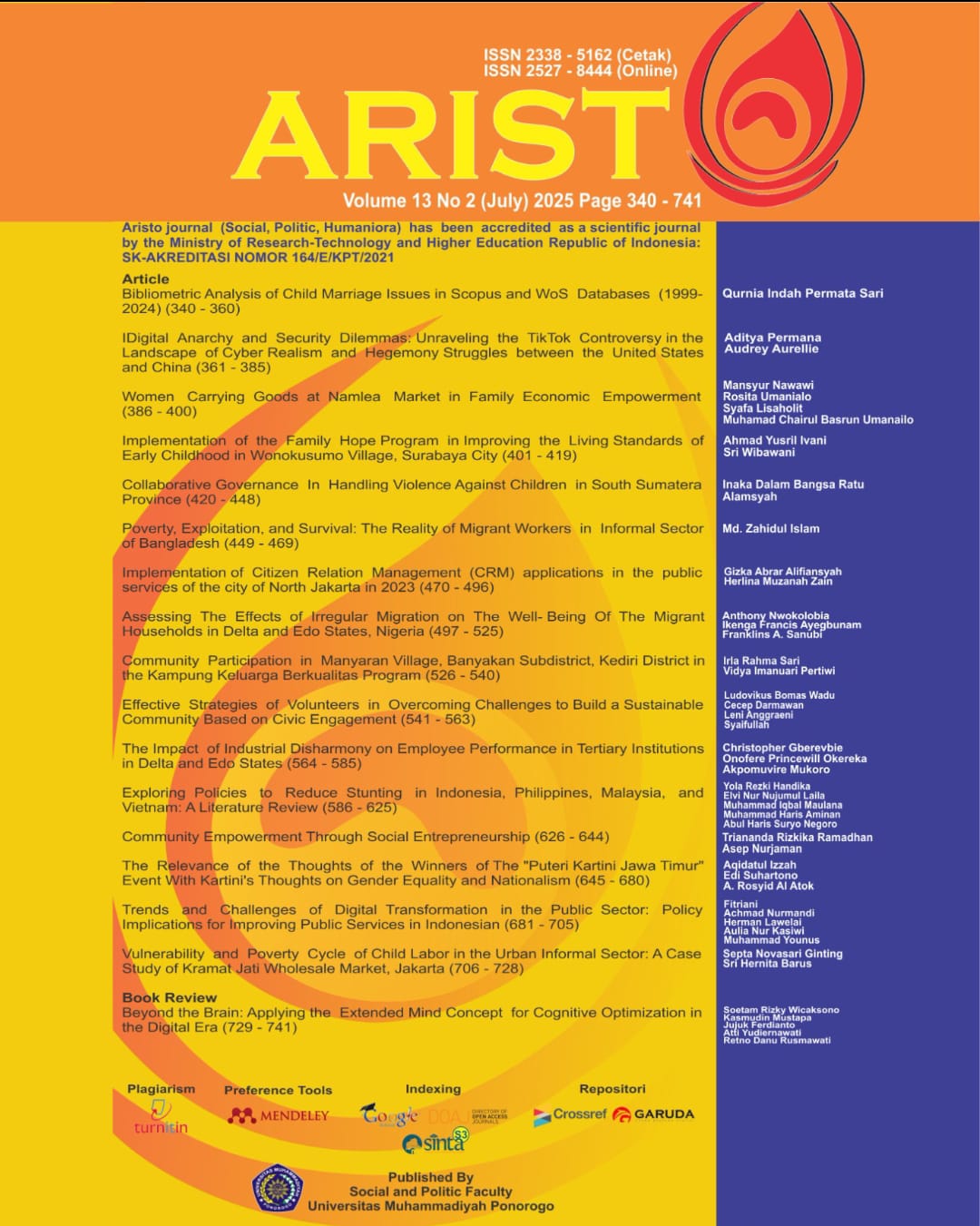
Poverty, Exploitation, and Survival: The Reality of Migrant Workers in Informal Sector of Bangladesh
DOI:
https://doi.org/10.24269/ars.v13i2.10341Abstract
Child violence is a critical issue within the 2030 Sustainable Development Goals, requiring a collaborative approach among agencies for effective management. This study examines the collaborative governance processes implemented by the South Sumatra Provincial Women's Empowerment and Child Protection Agency, the South Sumatra Regional Police, the Class I Palembang Correctional Service, and the Class I Palembang Child Correctional Institution. Utilizing a qualitative methodology, this research gathered primary and secondary data through observation, interviews, and documentation. Analysis based on the collaboration process theory by Ansell & Gash (2008) indicates that collaborative governance has been effective, characterized by face-to-face dialogue, trust-building, joint commitment, and shared understanding, as well as the achievement of interim results. However, improvements are needed in inter-agency communication and the development of Standard Operating Procedures (SOP) for handling child violence cases, to strengthen the collaborative process and achieve sustainable outcomes.
Downloads
References
Amin, M. (2021). Does Competition from Informal Firms Hurt Job Creation by Formal Firms? Evidence Using Firm-Level Survey Data. http://www.worldbank.org/prwp.
Bangasser, P. E. (2000). The ILO and the informal sector : an institutional history.
Berger, R. (2015). Now I see it, now I don’t: Researcher’s position and reflexivity in qualitative research. Qualitative research, 15(2), 219-234.
Braun, V., & Clarke, V. (2006). Using thematic analysis in psychology. Qualitative research in psychology, 3(2), 77-101.
Bryman, A. (2016). Social research methods. Oxford University Press.
Creswell, J. W., & Clark, V. L. P. (2017). Designing and conducting mixed methods research. Sage publications.
Creswell, J. W., & Poth, C. N. (2016). Qualitative inquiry and research design: Choosing among five approaches. Sage publications.
Denzin, N. K., & Lincoln, Y. S. (Eds.). (2011). The Sage handbook of qualitative research. sage.
DeVellis, R. F., & Thorpe, C. T. (2021). Scale development: Theory and applications. Sage publications.
Development Bank, A. (2010). The Informal Sector and Informal Employment in Bangladesh.
Field, A. (2013). Discovering statistics using IBM SPSS statistics.
Goldscheider, C. (2019). Migration and rural social structure: An overview. Rural Migration in Developing Nations: Comparative Studies of Korea, Sri Lanka, and Mali, 1–19. https://doi.org/10.4324/9780429305108-1/Migration-Rural-Social-Structure-Overview-Calvin-Goldscheider
Harun, H. H., Abdul Karim, M. K., Abd Rahman, M. A., Abdul Razak, H. R., Che Isa, I. N., & Harun, F. (2020). Establishment of CTPA Local Diagnostic Reference Levels with Noise Magnitude as a Quality Indicator in a Tertiary Care Hospital. Diagnostics, 10(9), 680. https://doi.org/10.3390/DIAGNOSTICS10090680
Islam, F. (2023). Terrorist Attack In The Holy Artisan Café, Bangladesh: An Analysis On News Framing. Journal of Asian and African Social Science and Humanities, 9(4), 12–25. https://doi.org/10.55327/JAASH.V9I4.315
Johnson, R. B., & Christensen, L. B. (2024). Educational research: Quantitative, qualitative, and mixed approaches. Sage publications.
Kaisar, M. J., Rahman, I., & Rahman, M. J. K. I. (2022). Religious Nationalism in Digitalscape: An Analysis of the Post-Shahbag Movement in Bangladesh. Open Journal of Social Sciences, 10(5), 201–218. https://doi.org/10.4236/JSS.2022.105015
Kumar, R. (2018). Research methodology: A step-by-step guide for beginners.
Kvale, S. (2009). Interviews: Learning the craft of qualitative research interviewing. Sage.
Likert, R. (1932). A technique for the measurement of attitudes. Archives of Psychology.
Lincoln, Y. S., & Guba, E. G. (1985). Naturalistic Inquiry. SAGE Publications.
Mujeri, M. K., & Mujeri, N. (2021). Structural Transformation of Bangladesh Economy. https://doi.org/10.1007/978-981-16-0764-6
Nurul, M., & Director, I. (n.d.). Overseas Employment From Bangladesh.
Parker, S. (2015). Urban theory and the urban experience: Encountering the city: Second edition. Urban Theory and the Urban Experience: Encountering the City: Second Edition, 1–289. https://doi.org/10.4324/9780203122402/Urban-Theory-Urban-Experience-Simon-Parker/Accessibility-Information
Patton, M. Q. (2002). Qualitative research methods and evaluation. Methods, Sage, Thousand Oaks.
Siddiqui, T., Development, A., & Manila, B. (2004). Efficiency of Migrant Workers’ Remittance: The Bangladesh Case.
Sifullah, M. K., Sohel, M. S., Hossain Sarker, M. F., Islam, M., Ahmad, M., & Rahman, M. M. (2023). Mapping out the vulnerabilities of migrant women in the informal sector: A qualitative investigation in Dhaka city. Heliyon, 9(10), e20950. https://doi.org/10.1016/J.HELIYON.2023.E20950
Sohel, M. S., Hossain, B., Alam, M. K., Shi, G., Shabbir, R., Sifullah, M. K., & Mamy, M. M. B. (2022). COVID-19 induced impact on informal migrants in Bangladesh: a qualitative study. International Journal of Sociology and Social Policy, 42(5–6), 473–497. https://doi.org/10.1108/IJSSP-02-2021-0046/FULL/PDF
Startup, R., & Startup, R. (2021). The Theory of the Selfish Gene Applied to the Human Population. Advances in Anthropology, 11(3), 179–200. https://doi.org/10.4236/AA.2021.113012
White, M. J., & Lindstrom, D. P. (2005). Internal Migration. Handbooks of Sociology and Social Research, 311–346. https://doi.org/10.1007/0-387-23106-4_12
Wichai Srikam, A. (n.d.). Urbanization and Urbanism in Thailand.
Zaman, N. T., Hossain, M. A., Sohel, M. S., Alam, J., Zafar, A., Hasan, M. N., & Obaydullah, M. (2024). Factors shaping female migrants to the informal sector in Bangladesh. SN Social Sciences 2024 4:10, 4(10), 1–36. https://doi.org/10.1007/S43545-024-00904-X
Downloads
Published
Issue
Section
License
Authors Who Publish whit this journal agree to the following term :
Copyright on any article is retained by the Journal
- Author grant the journal right of first publication with the work simultaneously licensed under a Creative Commons Attribution License that allows others to share the work with an acknowledgement of the work's authorship and initial publication in this;
- Authors are able to enter into separate, additional contractual arrangements for the non-exclusive distribution of the journal's published version of the work (e.g., post it to an institutional repository or publish it in a book), with an acknowledgement of its initial publication in this journal;
- Authors are permitted and encouraged to post their work online (e.g., in institutional repositories or on their website) prior to and during the submission process, as it can lead to productive exchanges, as well as earlier and greater citation of published work;
- Every accepted manuscript should be accompanied by Copyright Transfer Agreement (CTA), prior to the article publication. CTA can be downloaded here;
=====================================================================================================
Penulis yang mempublikasikan naskahnya pada Jurnal ini menyetujui ketentuan berikut:
Hak cipta pada setiap artikel adalah milik jurnal.
- Penulis mengakui bahwa Jurnal ARISTO berhak sebagai mempublikasikan pertama kali dengan bekerja secara bersamaan dibawah Creative Commons Attribution License yang memungkinkan orang lain untuk membagi pekerjaan dengan pengakuan dari pengarang dan publikasi pertama dalam jurnal ARISTO;
- Penulis dapat memasukan tulisan secara terpisah, mengatur distribusi non-ekskulif  dari naskah yang telah terbit di jurnal ini kedalam versi yang lain (misal: dikirim ke respository institusi penulis, publikasi kedalam buku, dll), dengan mengakui bahwa naskah telah terbit pertamakali pada Jurnal ARISTO;
- Penulis diperbolehkan dan didorong untuk mengirimkan pekerjaan mereka secara daring (misal melalui respositories atau website instansi penulis) sebelum atau selama proses pengiriman pada Jurnal ARISTO berlangsung, ini dapat menjadikan pertukaran informasi yang sangat produktif, dan serta menjadikan kutipan yang banyak dari publikasi;
- Setiap naskah yang diterima wajib menyertakan Perjanjian Pemindahan Hakcipta (Copyright Transfer Agreement/CTA), sebelum artikel diterbitkan. CTA dapat diunduh di sini


