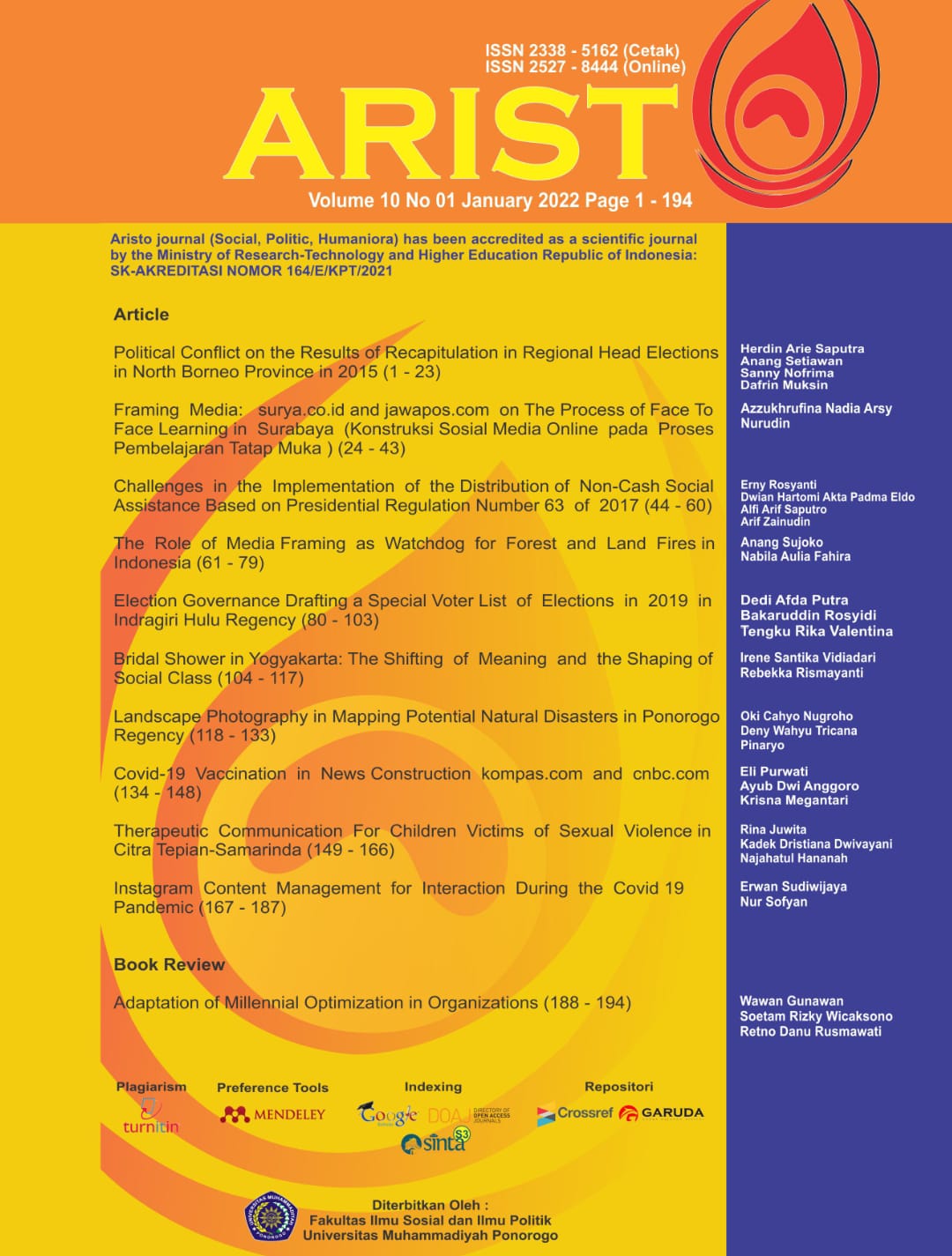
Instagram Content Management for Interaction During the Covid 19 Pandemic
DOI:
https://doi.org/10.24269/ars.v10i2.4066Abstract
Physical restrictions imposed during the pandemic stopped all concert activities, but @ykvvknd kept interacting with their followers. This study uses qualitative descriptive research method, where researchers collect data through field study techniques (interviews, observations, and document collection). These three data were collected through interviews. Our informant is the owner and manager of @ykvvknd content. Observations were made in the comment column for each @ykwknd content and document collection from articles in mass media. Authentic engagement is the only proven way for Instagram account managers to understand Gen Z, listen to them, and start forming relationships. Two-way communication among opinion leaders in their circle of friends is based on a high level of trust in opinion leaders.
Downloads
References
Ameen, N. and Anand, A. 2020. “Generation Z in the United Arab Emirates: A Smart-Tech-Driven IGenerationâ€, Gentina, E. and Parry, E. (Ed.).†Pp. 181–92 in The New Generation Z in Asia: Dynamics, Differences, Digitalisation (The Changing Context of Managing People). Emerald Publishing Limited.
Astuti, P. A., & amp; Freeman, B. 2021. “Perusahaan Rokok RAYU Anak Muda Dengan Konser MUSIK Dan Media Sosial.†Retrieved (https://theconversation.com/perusahaan-rokok-rayu-anak-muda-dengan-konser-musik-dan-media-sosial-94330).
Bianchi, C., and L. Andrews. 2018. “Consumer Engagement with Retail Firms through Social MEDIA: An Empirical Study in Chile.†International Journal of Retail & Distribution Management 46(4):364–385. doi: https://doi.org/10.1108/ijrdm-02-2017-0035.
Brandão, A., E. Pinho, and P. Rodrigues. 2019. “Antecedents and Consequences of Luxury Brand Engagement in Social Media.†Spanish Journal of Marketing 23(2):163–183. doi: https://doi.org/10.1108/sjme-11-2018-0052.
Chahal, H., and A. Rani. 2017. “How Trust Moderates Social Media Engagement and Brand Equity.†Journal of Research in Interactive Marketing 11(3):312–335. doi: https://doi.org/10.1108/jrim-10-2016-0104.
Chahal, H., J. Wirtz, and A. Verma. 2019. “Social Media Brand Engagement: Dimensions, Drivers and Consequences.†Journal of Consumer Marketing 37(2):191–204. doi: https://doi.org/10.1108/jcm-11-2018-2937.
Cheung, M. L., G. D. Pires, P. J. Rosenberger, and M. J. De Oliveira. 2020. “Driving Consumer–Brand Engagement and Co-Creation by Brand Interactivity.†Marketing Intelligence & Planning 38(4):523–541. doi: https://doi.org/10.1108/mip-12-2018-0587.
Cicilia, M. 2020. “Pertunjukan Musik Yang TETAP Berjalan Selama PANDEMI COVID-19.â€
Cui, L., Jiang, H., Deng, H. and Zhang, T. 2019. “The Influence of the Diffusion of Food Safety Information through Social Media on Consumers’ Purchase Intentions: An Empirical Study in China.†Data Technologies and Applications 53(2):230–48.
Davcik, N. S., Langaro, D., Jevons, C., & Nascimento, R. 2021. “Non-Sponsored Brand-Related User-Generated Content: Effects and Mechanisms of Consumer Engagement.†Journal of Product & Brand Management, Ahead-of-Print(Ahead-of-Print). doi: https://doi.org/10.1108/jpbm-06-2020-2971.
Dessart, L., C. Veloutsou, and A. Morgan-Thomas. 2020. “Consumer Engagement in Online Brand Communities: A Social Media Perspective.†Journal of Product & 14(2):239–268. doi: https://doi.org/10.1108/jrim-01-2020-0010.
Duncan, S. Y., R. Chohan, and J. J. Ferreira. 2019. “What Makes the Difference? Employee Social Media Brand Engagement.†Journal of Business & Industrial Marketing 34(7):1459–1467. doi: https://doi.org/10.1108/jbim-09-2018-0279.
Ennaji, F.Z., El Fazziki, A., El Alaoui El Abdallaoui, H., Benslimane, D. and Sadgal, M. 2018. “Opinion Leaders’ Prediction for Monitoring the Product Reputation.†International Journal of Web Information Systems 14(4):524–44.
Fernandes, T., and I. Inverneiro. 2020. “From Fandom to Fad: Are Millennials Really Engaged with and Loyal to Their Loved Brands on Social Media?†Journal of Product & Brand Management 30(2):320–334. doi: https://doi.org/10.1108/jpbm-02-2019-2262.
Florenthal, B. 2019. “Young Consumers’ Motivational Drivers of Brand Engagement Behavior on Social Media Sites.†Journal of Research in Interactive Marketing 13(3):351–391. doi: https://doi.org/10.1108/jrim-05-2018-0064.
Khan, I., H. Dongping, and A. Wahab. 2016. “Does Culture Matter in Effectiveness of Social Media Marketing Strategy? An Investigation of Brand Fan Pages.†Aslib Journal of Information Management 68(6):694–715. doi: https://doi.org/10.1108/ajim-03-2016-0035.
Kumar, J. 2021. “Understanding Customer Brand Engagement in Brand Communities: An Application of Psychological Ownership Theory and Congruity Theory. European Journal of Marketing.†European Journal of Marketing 4:55. doi: 10.1108/ejm-04-2018-0290.
Machado, J. C., C. C. Martins, F. C. Ferreira, S. C. Silva, and P. A. Duarte. 2020. “Motives to Engage with Sports Brands on Facebook And Instagram–The Case of a Portuguese Football Club.†International Journal of Sports Marketing and Sponsorship 21(2):325–349. doi: https://doi.org/10.1108/ijsms-06-2019-0066.
Mahoney, L. M., & Tang, T. 2017. Strategic Social Media: From Marketing to Social Change. Malden: MA: Wiley Blackwell.
Marques, I. R., B. Casais, and M. A. Camilleri. 2021. “The Effect OF Macrocelebrity and Microinfluencer Endorsements On Consumer–Brand Engagement in Instagram.†Strategic Corporate Communication in the Digital Age 131–43. doi: https://doi.org/10.1108/978-1-80071-264-520211008.
Milfeld, T. and Flint, D. J. 2021. “When Brands Take a Stand: The Nature of Consumers’ Polarized Reactions to Social Narrative Video.†Journal of Product & Brand Management 30(4):532–48.
Naqvi, M. H., Jiang, Y., & Naqvi, M. 2020. “Generating Customer Engagement in Electronic-Brand Communities: A Stimulus–Organism–Response Perspective.†Asia Pacific Journal of Marketing and Logistics, Ahead-of-Print. doi: 10.1108/apjml-01-2020-0053.
Osei-Frimpong, K. 2019. “Understanding Consumer Motivations in Online Social Brand Engagement Participation.†International Journal of Retail & Distribution Management 47(5):511–529. doi: https://doi.org/10.1108/ijrdm-08-2018-0151.
Park, H. and Jiang, Y. 2020. “A Human Touch and Content Matter for Consumer Engagement on Social Media.†Corporate Communications: An International Journal.
Pasaribu, A., & Yuniar, N. 2019. “Ketika Indie Menjadi Arus Utama, Bagaimana Dengan Musik Rock?â€
Read, W., N. Robertson, L. McQuilken, and A. S. Ferdous. 2019. “Understanding Consumer Motivations in Online Social Brand Engagement Participation.†European Journal of Marketing 53(9):1905–1933. doi: https://doi.org/10.1108/ejm-10-2017-0772.
Santia, T. 2021. “Wacana Larangan Iklan Rokok Dinilai Tak Adil.â€
Saraswati, D. 2020. “Konser Musik DISEBUT Jadi Yang PALING Terakhir PULIH Karena Pandemi.†Retrieved (https://hot.detik.com/music/d-5182921/konser-musik-disebut-jadi-yang-paling-terakhir-pulih-karena-pandemi).
Sawhney, M. and Goodman, P. 2021. “The Hunger Games: Catching Fire: Using Digital and Social Media for Brand Storytelling.†Kellogg School of Management Cases.
Vander Schee, B. A., J. Peltier, and A. J. Dahl. 2020. “Antecedent Consumer Factors, Consequential Branding Outcomes and Measures of Online Consumer Engagement: Current Research and Future Directions.†Journal of Research in Interactive Marketing 14(2):239–268. doi: https://doi.org/10.1108/jrim-01-2020-0010.
Setuningsih, N. 2020. “5 Fakta Menarik KONSER Dan FESTIVAL Musik Setelah Pandemi Covid-19.â€
Sorensen, A., Andrews, L. and Drennan, J. 2017. “Using Social Media Posts as Resources for Engaging in Value Co-Creation: The Case for Social Media-Based Cause Brand Communities.†Journal of Service Theory and Practice 27(4):898–922.
Sujoko, Anang. 2020. “Merancang Model Pemberdayaan Komunikasi Politik Yang Interaktif.†ARISTO 8(1):62–81. doi: http://dx.doi.org/10.24269/ars.v8i1.2261.
Sulistyawati, Anik. 2020. “Mengungkap Platform Yang Paling Banyak Digunakan Milenial Untuk Cari Berita.†Solopos.Com. Retrieved (https://www.solopos.com/mengungkap-platform-yang-paling-banyak-digunakan-milenial-untuk-cari-berita-1099479).
Susanti, E., M. Rafika, and T. Melinda. 2021. “Consumer Brand Engagement on Brand Loyalty: The Role of Brand Satisfaction as a Mediating Variable.†KnE Social Sciences. doi: https://doi.org/10.18502/kss.v5i5.8818.
Thanh Ha, L.T. and Thu, V. T. 2020. “Motivations of Guests Contributing SWOM on Social Media: A Case in Vietnam.†Journal of Asian Business and Economic Studies.
Triantafillidou, A. and Siomkos, G. 2018. “The Impact of Facebook Experience on Consumers’ Behavioral Brand Engagement.†Journal of Research in Interactive Marketing 12(2):164–92.
Wahyudi, R. 2020. “Apa ITU Shadowban Instagram, Penyebab Dan Cara Mengatasinya.†KOMPAS.Com. Retrieved (https://tekno.kompas.com/read/2020/12/10/19200067/apa-itu-shadowban-instagram-penyebab-dan-cara-mengatasinya?page=all.).
Wallace, E., P. Torres, M. Augusto, and M. Stefuryn. 2021. “Do Brand Relationships on Social Media Motivate Young Consumers’ Value Co-Creation and Willingness to Pay? The Role of Brand Love.†Journal of Product & Brand Management, Ahead-of-Print(Ahead-of-Print). doi: https://doi.org/10.1108/jpbm-06-2020-2937.
Witt, G. L., & Baird, D. E. 2018. GEN Z FREQUENCY: How Brands Tune in and Build Credibility. New Delhi, India: KOGAN PAGE.
Downloads
Published
Issue
Section
License
Authors Who Publish whit this journal agree to the following term :
Copyright on any article is retained by the Journal
- Author grant the journal right of first publication with the work simultaneously licensed under a Creative Commons Attribution License that allows others to share the work with an acknowledgement of the work's authorship and initial publication in this;
- Authors are able to enter into separate, additional contractual arrangements for the non-exclusive distribution of the journal's published version of the work (e.g., post it to an institutional repository or publish it in a book), with an acknowledgement of its initial publication in this journal;
- Authors are permitted and encouraged to post their work online (e.g., in institutional repositories or on their website) prior to and during the submission process, as it can lead to productive exchanges, as well as earlier and greater citation of published work;
- Every accepted manuscript should be accompanied by Copyright Transfer Agreement (CTA), prior to the article publication. CTA can be downloaded here;
=====================================================================================================
Penulis yang mempublikasikan naskahnya pada Jurnal ini menyetujui ketentuan berikut:
Hak cipta pada setiap artikel adalah milik jurnal.
- Penulis mengakui bahwa Jurnal ARISTO berhak sebagai mempublikasikan pertama kali dengan bekerja secara bersamaan dibawah Creative Commons Attribution License yang memungkinkan orang lain untuk membagi pekerjaan dengan pengakuan dari pengarang dan publikasi pertama dalam jurnal ARISTO;
- Penulis dapat memasukan tulisan secara terpisah, mengatur distribusi non-ekskulif  dari naskah yang telah terbit di jurnal ini kedalam versi yang lain (misal: dikirim ke respository institusi penulis, publikasi kedalam buku, dll), dengan mengakui bahwa naskah telah terbit pertamakali pada Jurnal ARISTO;
- Penulis diperbolehkan dan didorong untuk mengirimkan pekerjaan mereka secara daring (misal melalui respositories atau website instansi penulis) sebelum atau selama proses pengiriman pada Jurnal ARISTO berlangsung, ini dapat menjadikan pertukaran informasi yang sangat produktif, dan serta menjadikan kutipan yang banyak dari publikasi;
- Setiap naskah yang diterima wajib menyertakan Perjanjian Pemindahan Hakcipta (Copyright Transfer Agreement/CTA), sebelum artikel diterbitkan. CTA dapat diunduh di sini


