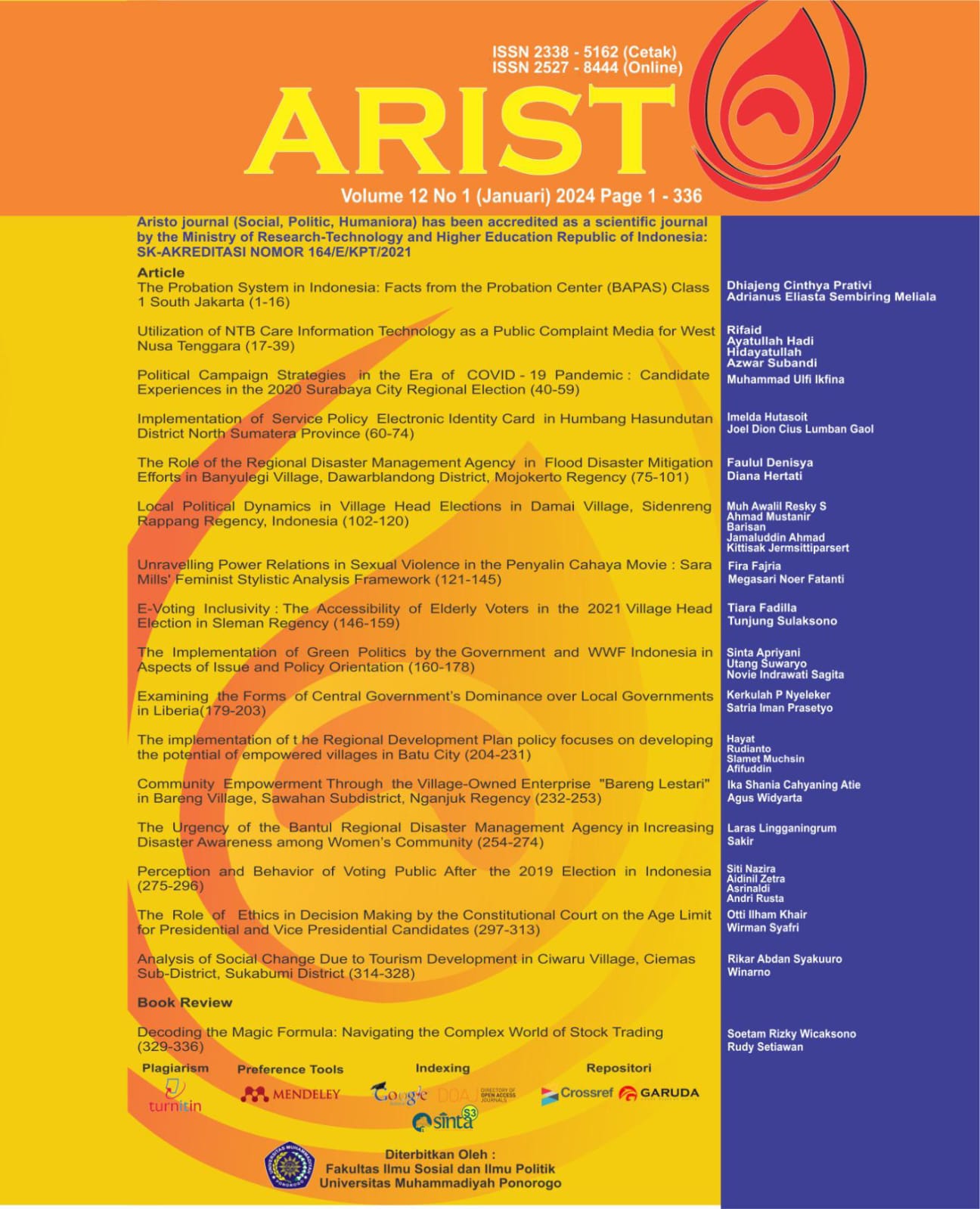
The Implementation of Green Politics by the Government and WWF Indonesia in Aspects of Issue and Policy Orientation
DOI:
https://doi.org/10.24269/ars.v12i1.7026Abstract
The issue of the environmental crisis is increasingly getting the attention of the world community. in addition to the government, the community may also contribute to protecting the environment and saving the earth. moreover, this study used a qualitative approach. a literature study is the data collection technique that was employed. the results of research activities conducted by wwf indonesia obtained outcomes that aligned with the main activities achieved based on the planning that was implemented, regulations formed from activities, and interventions involving stakeholders. thus, the government and wwf indonesia have an impact on each other when it comes to the issue orientation aspect of implementing green politics. furthermore, initiatives from wwf indonesia have the potential to shed light on forest sustainability on the island of kalimantan. however, the environmental movement encompasses more than merely the aspect of realizing policy. every environmentally committed institution also serves the wider community by providing education pertaining to the environment. according to the program table, the program’s implementation for the working period has ended, so it is currently required to clarify the follow-up on which program will be implemented next. this condition also indicates that there was no turning point for the relevant sector government when the responsibility devolved to WWF indonesia, and ultimately, this program was discontinued.
Downloads
References
Collins, D. (2010). Hot, Flat, and Crowded: Why We Need a Green Revolution—and How It Can Renew America, by Thomas L. Friedman. New York: Farrar, Straus and Giroux, 2008. Hardcover, 448 pages, $27.95. ISBN-10: 0-374-16685-4. Business Ethics Quarterly, 20(1), 127–134. https://doi.org/10.5840/beq20102019
Creswell, J. W. (2016). Reflections on the MMIRA The Future of Mixed Methods Task Force Report. Journal of Mixed Methods Research, 10(3), 215–219. https://doi.org/10.1177/1558689816650298
Fadli, Mukhlis & Lutfi, M. (2016). Hukum & kebijakan lingkungan (Cetakan pertama). UB Press.
Greenwood, C. (2019). WWF for Living Planet. WWF Indonesia.
Hasanal Bolqiah, L., & Raffiudin, R. (2020). Dominasi Oligarki dan Ketidakhadiran Partai Politik Hijau di Indonesia. Nakhoda: Jurnal Ilmu Pemerintahan, 19(2), 151–167. https://doi.org/10.35967/njip.v19i2.112
Heart Of Borneo. (2019). Laporan Evaluasi dari Implementasi Renstranas HoB 2015 – 2019. WWF Indonesia.
Hutabarat, G. F. I. (2022). Kajian Green Politic Theory Dalam Upaya Menangani Deforestasi Papua Terkait Aktivitas Ekspansi. 7(2).
Kementerian Keuangan. (2021). Green Sukuk dari Indonesia Untuk Dunia: Vol. Volume 1 Nomor 2, Tahun 2021. Buletin SSN.
Kementerian Keuangan, 2021. (t.t.).
Murtasidin, B., & Sigalingging, B. M. (2020). Dimensi Ekologi Politik Dalam Kerjasama Voluntary Partnership Agreement (VPA) Indonesia-Uni Eropa. Jdp (Jurnal Dinamika Pemerintahan), 3(1), 1–11. https://doi.org/10.36341/jdp.v3i1.1167
Narzary, R. (2021). Green Politics To Achieve Sustainable Growth In India. PalArch’s Journals of Archaelogy of Egypt, 18(1).
Nurmardiansyah, E. (2015). Konsep Hijau: Penerapan Green Constitution Dan Green Legislation Dalam Rangka Eco-Democracy. Veritas et Justitia, 1(1). https://doi.org/10.25123/vej.1422
Nuwer, R. (2014). Borneo Has Lost 30 Percent of Its Forest in the Past 40 Years. Smithsonian Magazine. https://www.smithsonianmag.com/smart-news/borneo-has-lost-30-percent-its-forest-cover-past-40-years-180952072/
P. K. Blind, “Building Trust In Government In The Twenty-First Century,†Expert Associate UNDESA, no. Review of Literature and Emerging
Pickering, J., Bäckstrand, K., & Schlosberg, D. (2020). Between environmental and ecological democracy. Journal of Environmental Policy & Planning, 22(1), 1–15. https://doi.org/10.1080/1523908X.2020.1703276
Rakhman, M. A. (2020). Dinamika Peran Ngo Lingkungan Hidup Dalam Arena Politik Lokal Di Provinsi Jambi. 4(4).
Rasyid, I., & Felixiani Keviola, J. R. (2020). Gerakan Earth Hour Tangerang Dalam Perspektif Politik Lingkungan. ijd-demos, 2(2). https://doi.org/10.37950/ijd.v2i2.42
Robbins, P. (2014). Political Ecology.
Said, M. Y., & Nurhayati, Y. (2020). Paradigma Filsafat Etika Lingkungan Dalam Menentukan Arah Politik Hukum Lingkungan. Al-Adl : Jurnal Hukum, 12(1), 39. https://doi.org/10.31602/al-adl.v12i1.2598
Stolar, E. A. (2019). Green Politics: The Impact of Grassroots Organizations on Environmental Political Movement. Fordham University.
Sugiyono. (2016). Metode Penelitian Kuantitatif, Kualitatif, R&D. IKAPI.
Supratiwi. (2013). Partai Politik & Politik Hijau: Studi tentang Kepedulian Parpol terhadap Politik yang Prolingkungan di Kota Semarang. Politika: Jurnal Ilmu Politik, 109–117. https://doi.org/10.14710/politika.2.1.2011.109-117
Downloads
Additional Files
Published
Issue
Section
License
Authors Who Publish whit this journal agree to the following term :
Copyright on any article is retained by the Journal
- Author grant the journal right of first publication with the work simultaneously licensed under a Creative Commons Attribution License that allows others to share the work with an acknowledgement of the work's authorship and initial publication in this;
- Authors are able to enter into separate, additional contractual arrangements for the non-exclusive distribution of the journal's published version of the work (e.g., post it to an institutional repository or publish it in a book), with an acknowledgement of its initial publication in this journal;
- Authors are permitted and encouraged to post their work online (e.g., in institutional repositories or on their website) prior to and during the submission process, as it can lead to productive exchanges, as well as earlier and greater citation of published work;
- Every accepted manuscript should be accompanied by Copyright Transfer Agreement (CTA), prior to the article publication. CTA can be downloaded here;
=====================================================================================================
Penulis yang mempublikasikan naskahnya pada Jurnal ini menyetujui ketentuan berikut:
Hak cipta pada setiap artikel adalah milik jurnal.
- Penulis mengakui bahwa Jurnal ARISTO berhak sebagai mempublikasikan pertama kali dengan bekerja secara bersamaan dibawah Creative Commons Attribution License yang memungkinkan orang lain untuk membagi pekerjaan dengan pengakuan dari pengarang dan publikasi pertama dalam jurnal ARISTO;
- Penulis dapat memasukan tulisan secara terpisah, mengatur distribusi non-ekskulif  dari naskah yang telah terbit di jurnal ini kedalam versi yang lain (misal: dikirim ke respository institusi penulis, publikasi kedalam buku, dll), dengan mengakui bahwa naskah telah terbit pertamakali pada Jurnal ARISTO;
- Penulis diperbolehkan dan didorong untuk mengirimkan pekerjaan mereka secara daring (misal melalui respositories atau website instansi penulis) sebelum atau selama proses pengiriman pada Jurnal ARISTO berlangsung, ini dapat menjadikan pertukaran informasi yang sangat produktif, dan serta menjadikan kutipan yang banyak dari publikasi;
- Setiap naskah yang diterima wajib menyertakan Perjanjian Pemindahan Hakcipta (Copyright Transfer Agreement/CTA), sebelum artikel diterbitkan. CTA dapat diunduh di sini


