Impact of Social Media on Child Prostitution Network in Pontianak City (Case Study of Rumah Aman Kota Pontianak)
DOI:
https://doi.org/10.24269/ars.v12i2.7132Abstract
The misuse of social media for child prostitution in Pontianak City has increased in recent years, this requires mutual attention. This study aims to describe the types of social media used by online prostitutes in interacting and communicating, and then to describe how social media forms child prostitution networks in Pontianak. The data collection methods carried out are observation, interview, documentation, and data analysis, while this study uses a descriptive qualitative research method approach. In this study, the subjects of this study were officers of the Pontianak City Safe House and the agency that revealed the case, namely the KPPAD team. The results of this study show that social media is an alternative for child commercial sex workers in Pontianak. Related to social media, the most widely used social media is MiChat and WhatsApp GB, besides that social media such as Facebook is also used but not the main one. Furthermore, the results of the study also show that the function of social media is divided into two, namely social media is access to involvement of children in prostitution cases, second social media can form new networks in child prostitution. From the two results of the study, it can be concluded that social media has formed online child prostitution through child online prostitution networks, namely these networks can be formed anytime, anywhere, and by anyone. In addition, as long as social media are labelled as media providers of prostitution services still exist and are easy to download, then social media can form or regenerate new networks.
Downloads
References
Annur, C. M. (2022, September 7). Pengguna WhatsApp Terus Bertambah, Ini Jumlahnya Sekarang. Databoks.Katadata.Co.Id. https://databoks.katadata.co.id/datapublish/2022/09/07/pengguna-whatsapp-terus-bertambah-ini-jumlahnya-sekarang
Anttiroiko, A.-V. (2015). Castells’ Network Concept and Its Connections to Social, Economic and Political Network Analyses. Journal of Social Structure. https://doi.org/10.21307/joss-2019-021
Arsanti, M. (2017). Penggunaan Media Sosial Sebagai Sarana Prostitusi Online. 5(3), 50–62.
Asogwa, C. E. (2020). Internet-Based Communications: A Threat or Strength to National Security? Sage Open. https://doi.org/10.1177/2158244020914580
Asur, S., Huberman, B. A., Szabó, G., & Wang, C. (2011). Trends in Social Media: Persistence and Decay. SSRN Electronic Journal. https://doi.org/10.2139/ssrn.1755748
Bajan, A. (2015). Paradigms of the Religious Network Society. Stream: Interdisciplinary Journal of Communication, 7(1), 9–15. https://doi.org/10.21810/strm.v7i1.119
Bakardjieva, M. (2014). Social Media and the McDonaldization of Friendship. Communications. https://doi.org/10.1515/commun-2014-0017
Beigi, G. (2018). Social Media and User Privacy. http://arxiv.org/abs/1806.09786
Castells, M. (2022). The Network Society Revisited. American Behavioral Scientist. https://doi.org/10.1177/00027642221092803
Costa, C. M., Quintanilha, T. L., & Mendonça, S. (2019). Manuel Castells and informationalism 1. In Management, Organizations and Contemporary Social Theory (pp. 256–270). Routledge. https://doi.org/10.4324/9780429279591-14
datareportal.com. (2023, February 9). The State of Digital In Indonesia In 2023. Datareportal.Com. https://datareportal.com/reports/digital-2023-indonesia
Décieux, J. P., Heinen, A., & Willems, H. (2019). Social Media and Its Role in Friendship-driven Interactions among Young People: A Mixed Methods Study. YOUNG, 27(1), 18–31. https://doi.org/10.1177/1103308818755516
Dewi, A. C., Agung Ayu Oka Saraswati, & Wiryawan, I. W. (2017). Program Fungsional Rumah AMAN Anak. E-Jurnal Arsitektur Universitas Udayana, 5(2).
Efendi, Z. (2021). Analisis Komunikasi pada Aplikasi MiChat sebagai Sarana Media Prostitusi Online di Pontianak. Panangkaran: Jurnal Penelitian Agama Dan Masyarakat, 4(2). https://doi.org/10.14421/panangkaran.2020.0402-06
Efendi, Z., & Eka Apriliani, D. (2020). Analisis Komunikasi Pada Aplikasi Michat Sebagai Sarana Media Prostitusi Online Di Pontianak. In Analisis Komunikasi pada Aplikasi MiChat (Vol. 4, Issue 2).
Efevbera, Y., Bhabha, J., Farmer, P. E., & Fink, G. (2017). Girl child marriage as a risk factor for early childhood development and stunting. Social Science & Medicine, 185, 91–101. https://doi.org/https://doi.org/10.1016/j.socscimed.2017.05.027
Efthariena, E., Lestari, L., Ferdiansyah, F., Arifah, A., & Khanivah, K. (2022). Pola Komunikasi Media Sosial Pada Pelaku Prostitusi Online di Aplikasi Michat. Jurnal Sosial Teknologi, 2(8). https://doi.org/10.36418/jurnalsostech.v2i8.397
Fathonah, R. (2016). Analisis Terhadap Faktor Penyebab Prostitusi Pada Anak. Jurnal Poenale, 3(4).
Febriawan, D. (2022, June 27). KPPAD Kalbar; Prostitusi di Pontianak diprediksi meningkat diakhir tahun. Https://Wartapontianak.Pikiran-Rakyat.Com. https://wartapontianak.pikiran-rakyat.com/kalbar/pr-1171087680/prostitusi-di-pontianak-diprediksi-meningkat-di-akhir-tahun
Fedina, L., Williamson, C., & Perdue, T. (2016). Risk Factors for Domestic Child Sex Trafficking in the United States. https://doi.org/10.1177/0886260516662306
Fernández-Ardèvol, M., & Ribera-Fumaz, R. (2022). The Network Society Today. American Behavioral Scientist. https://doi.org/10.1177/00027642221092800
Firdaus, D. R. S., & Regieri, J. (2022). The Communication Pattern of Online Prostitution Business that Violates Intellectual Property Rights. Proceedings of the 7th International Conference on Social and Political Sciences (ICoSaPS 2022), 413–424. https://doi.org/10.2991/978-2-494069-77-0_56
Glowacz, F., & Schmits, E. (2020). Psychological distress during the COVID-19 lockdown: The young adults most at risk. Psychiatry Research, 293, 113486. https://doi.org/10.1016/j.psychres.2020.113486
Hanley, J. (2021). Networks of Power and Counterpower in Social Work With Children and Families in England. Critical Social Policy. https://doi.org/10.1177/02610183211034727
Herzig, B., & Aßmann, S. (2014). How to Define Media in a Mediatized Society? A Media Pedagogical Proposal Inspired by Theoretical Ideas of ¬Castells, Luhmann and Peirce. Medienpädagogik Zeitschrift Für Theorie Und Praxis Der Medienbildung. https://doi.org/10.21240/mpaed/24/2014.07.18.x
Hidayat, A. R., & Liauw, F. (2021). Rumah Aman Untuk Korban Kekerasan Seksual. Jurnal Sains, Teknologi, Urban, Perancangan, Arsitektur (Stupa), 3(1), 341. https://doi.org/10.24912/stupa.v3i1.10750
Irawan, F., Gultom, I., & Amsani, H. (2019). Media Sosial Dalam Jaringan Prostitusi Mahasiswa Di Kota Medan. Jurnal Antropologi Sumatera, 17(2), 89–95.
Juditha, C., Maryani, E., Abdullah, A., & Setiawati, R. (2022). Promotion of Prostitution Services on Social Media. Jurnal Komunikasi Malaysian Journal of Communication. https://doi.org/10.17576/jkmjc-2022-3802-01
kalbaronline.com. (2022, November 19). Prostitusi Anak Bawah Umur Kian Marak di Pontianak. Kalbaronline.Com. https://www.kalbaronline.com/2022/11/19/prostitusi-anak-bawah-umur-kian-marak-di-pontianak/
KEPRES No 88. (2022). Keputusan Presiden No 88 Tahun 2022 tentang Rencana Aksi Nasional Penghapusan Perdagangan Perempuan dan Anak.
Kompas TV. (2020a, December 18). Kasus Mulai Marak, KPPAD Ajak Masyarakat Perangi Prostitusi Online. Kompas TV. https://www.youtube.com/watch?v=slyOLrjjT4c
Kompas TV. (2020b, December 31). Miris Prostitusi Anak Di Bawah Umur Menggunakan Medsos. Kompas TV. https://www.youtube.com/watch?v=Y7aoxAl1_gw
KPPAD Kalimantan Barat. (2023). Komisi Perlindungan dan Pengawasan Anak Daerah Kalimantan Barat .
Kumparan.com. (2022, January 13). Prostitusi Online via MiChat di Pontianak Libatkan Anak, Tarifnya Rp 300 Ribu. Kumparan.Com. https://kumparan.com/hipontianak/prostitusi-online-via-michat-di-pontianak-libatkan-anak-tarifnya-rp-300-ribu-1xIcWphTZbx
Laksana, T. A., Ohoiwutun, Y. A. T., & Tanuwijaya, F. (2019a). Formulating Criminal Liabilities Regarding Online Prostitution. Lentera Hukum. https://doi.org/10.19184/ejlh.v6i3.14671
Laksana, T. A., Ohoiwutun, Y. A. T., & Tanuwijaya, F. (2019b). Formulating Criminal Liabilities Regarding Online Prostitution. Lentera Hukum. https://doi.org/10.19184/ejlh.v6i3.14671
Li, S. (2017). Some Sociological Issues of the Information-Internet Engineering. Proceedings of the IS4SI 2017 Summit DIGITALISATION FOR A SUSTAINABLE SOCIETY, Gothenburg, Sweden, 12–16 June 2017., 109. https://doi.org/10.3390/IS4SI-2017-03950
Mahendra, K. D. O., & Ari Mogi, I. K. (2021). Digital Forensic Analysis Of Michat Application On Android As Digital Proof In Handling Online Prostitution Cases. JELIKU (Jurnal Elektronik Ilmu Komputer Udayana), 9(3), 381. https://doi.org/10.24843/JLK.2021.v09.i03.p09
MarÃn, V. I., Carpenter, J. P., & Tur, G. (2021). Preâ€service teachers’ perceptions of social media data privacy policies. British Journal of Educational Technology, 52(2), 519–535. https://doi.org/10.1111/bjet.13035
Miles, M. B. H. A. M., & Saldana, J. (2014). Qualitative Data Analysis, A Methods Sourcebook, Edition 3 (3rd ed.). USA: Sage Publications. Terjemahan Tjetjep Rohindi Rohidi, UI-Press.
Mohammed, M. T. S., Ibrahim, F., & Yunus, N. (2021). Exploring the Relationship of Social Media Usage and Multitasking of Social Media on Self-Efficacy and Academic Performance. Jurnal Komunikasi Malaysian Journal of Communication. https://doi.org/10.17576/jkmjc-2021-3701-13
Novarizal, R. (2020). Tinjauan Viktimologi Pada Anak Korban Prostitusi (Studi Kasus “X†Di Pekanbaru). https://doi.org/10.25299/sisilainrealita.2019.vol4(2).4828
Nurgiansah, T. H. (2020). Fenomena Prostitusi Online di Kota Yogyakarta dalam Perspektif Nilai Kemanusiaan Yang Adil dan Beradab. Jurnal Kewarganegaraan, 17(1). https://doi.org/10.24114/jk.v17i1.14208
Nurmansyah, R. (2020, August 12). Lewat Aplikasi MiChat, 5 Anak Dibawah Umur Terlibat Prostitusi Online. Suara.Com. https://www.suara.com/news/2020/08/12/160430/lewat-aplikasi-michat-5-anak-dibawah-umur-terlibat-prostitusi-online?page=all
Nuzulita, N., & Subriadi, A. P. (2020). The role of riskâ€benefit and privacy analysis to understand different uses of social media by Generations X, Y, and Z in Indonesia. The Electronic Journal of Information Systems in Developing Countries, 86(3). https://doi.org/10.1002/isd2.12122
O’hara, M. (2018). Making Pimps and Sex Buyers Visible: Recognising the Commercial Nexus in ‘Child Sexual Exploitation.’ https://doi.org/10.1177/0261018318764758
Olivier, B. (2022). Time(s), Space(s) and Communication in Castells’s ‘Network Society’*. Communicare Journal for Communication Studies in Africa. https://doi.org/10.36615/jcsa.v33i2.1635
Pacheco-Montoya, D., Murphy-Graham, E., Valencia López, E. E., & Cohen, A. K. (2022). Gender Norms, Control Over Girls’ Sexuality, and Child Marriage: A Honduran Case Study. Journal of Adolescent Health, 70(3, Supplement), S22–S27. https://doi.org/https://doi.org/10.1016/j.jadohealth.2021.11.007
Permata, V. H. (2021). Online Prostitution Amidst the Rapid Technological Advances: Legal and Social Aspects. Semarang State University Undergraduate Law and Society Review. https://doi.org/10.15294/lsr.v1i1.49837
Rahayu, R. (2023, January 17). Gaet Pelanggan dengan 7 Fitur WhatsApp Business. Trenasia.Com. https://www.trenasia.com/gaet-pelanggan-dengan-7-fitur-whats-app-business-berikut
Rahmawati, W. H. (2020). Pertanggungjawaban Pidana Pengguna Jasa Prostitusi Online. Media Iuris, 3(3). https://doi.org/10.20473/mi.v3i3.23047
Ritzer, G. (2015). The “New†World of Prosumption: Evolution, “Return of the Same,†or Revolution? Sociological Forum. https://doi.org/10.1111/socf.12142
Ritzer, G., & Jeffrey, S. (2019). Teori Sosiologi Edisi 10 (10th ed.). Pustaka Pelajar.
Rocha, L. E. C., Liljeros, F., & Holme, P. (2010a). Information Dynamics Shape the Sexual Networks of Internet-Mediated Prostitution. Proceedings of the National Academy of Sciences. https://doi.org/10.1073/pnas.0914080107
Rocha, L. E. C., Liljeros, F., & Holme, P. (2010b). Information Dynamics Shape the Sexual Networks of Internet-Mediated Prostitution. Proceedings of the National Academy of Sciences. https://doi.org/10.1073/pnas.0914080107
Römmele, A., & Pfetsch, B. (2015). Social Science and the Media. https://doi.org/10.1016/b978-0-08-097086-8.41062-7
Sarkhoh, N., & KhosraviNik, M. (2020). Social Media Discourses of Arabism and the Negotiation of Self in the Middle East. World Englishes. https://doi.org/10.1111/weng.12502
Setyawan, D. (2014). KPAI: 13.000 Anak Rentan Jadi Korban Prostitusi “Online.†An,Http://Www.Kpai.Go.Id/Berita/Kpai-13-000-Anak-Rentan-Jadi-Korban Prostitusi-Online.
Shade, L. R., & Singh, R. (2016). “Honestly, We’re Not Spying on Kidsâ€: School Surveillance of Young People’s Social Media. Social Media + Society, 2(4), 205630511668000. https://doi.org/10.1177/2056305116680005
Sudirmansyah, H. (2020, August 12). Terungkap Prostitusi Online Di Pontianak Kalbar Libatkan Anak Di Bawah Umur, Demi Gaya Hidup. Pontianak.Tribunnews.Com. https://pontianak.tribunnews.com/2020/08/12/terungkap-prostitusi-lewat-michat-di-pontianak-kalbar-libatkan-anak-di-bawah-rela-demi-gaya-hidup.
Sugiyono. (2017). Metode Penelitian Kualitatif. PT. Remaja Rosdakarya Press.
tvonenews.com. (2022, January 13). Prostitusi Online Anak di Bawah Umur di Pontianak Terungkap, 9 Mucikari Dibekuk . Tvonenews.Com.
Wahab, Z. A., Kurnaesih, E., & Multazam, A. (2020). Prostitusi Pada Mahasiswi Melalui Layanan Media Online Di Kota Makassar Tahun 2020. Journal of Aafiyah Health Research (JAHR), 1(1). https://doi.org/10.52103/jahr.v1i1.91
Wahyuni Purbohastuti. (2017). Efektivitas Media Sosial Sebagai Media Promosi (Vol. 12, Issue 2).
Wasis, ., & Nurzakiah, . (2022a). The Need for Criminalizing Online Prostitution in Indonesia. Kne Social Sciences. https://doi.org/10.18502/kss.v7i15.12108
Wasis, ., & Nurzakiah, . (2022b). The Need for Criminalizing Online Prostitution in Indonesia. Kne Social Sciences. https://doi.org/10.18502/kss.v7i15.12108
Wicaksono, I., Bahtiar, B., & Maulana, A. (2021). Pelatihan Pembuatan Rencana Pembangunan Jangka Menengah Desa (RPJM Desa) Di Randuagung Sumberjambe Jember. Jurnal Pengabdian Masyarakat Manage, 2(1). https://doi.org/10.32528/jpmm.v2i1.5000
Yudhistira, A. A., & Jaya, J. N. U. (2022). Analisis Tingkat Penggunaan Aplikasi MiChat Sebagai Sarana Media Bisnis Prostitusi Online Menggunakan Metode TAM. JURIKOM (Jurnal Riset Komputer), 9(3), 600. https://doi.org/10.30865/jurikom.v9i3.4159
Yuliani, P. A. (2020). Temuan KPAI: Prostitusi Anak Meningkat selama Pandemi. Https://Mediaindonesia.Com .
Zaini, M., & Soenarto, S. (2019). Persepsi Orangtua Terhadap Hadirnya Era Teknologi Digital di Kalangan Anak Usia Dini. Jurnal Obsesi : Jurnal Pendidikan Anak Usia Dini, 3(1), 254. https://doi.org/10.31004/obsesi.v3i1.127
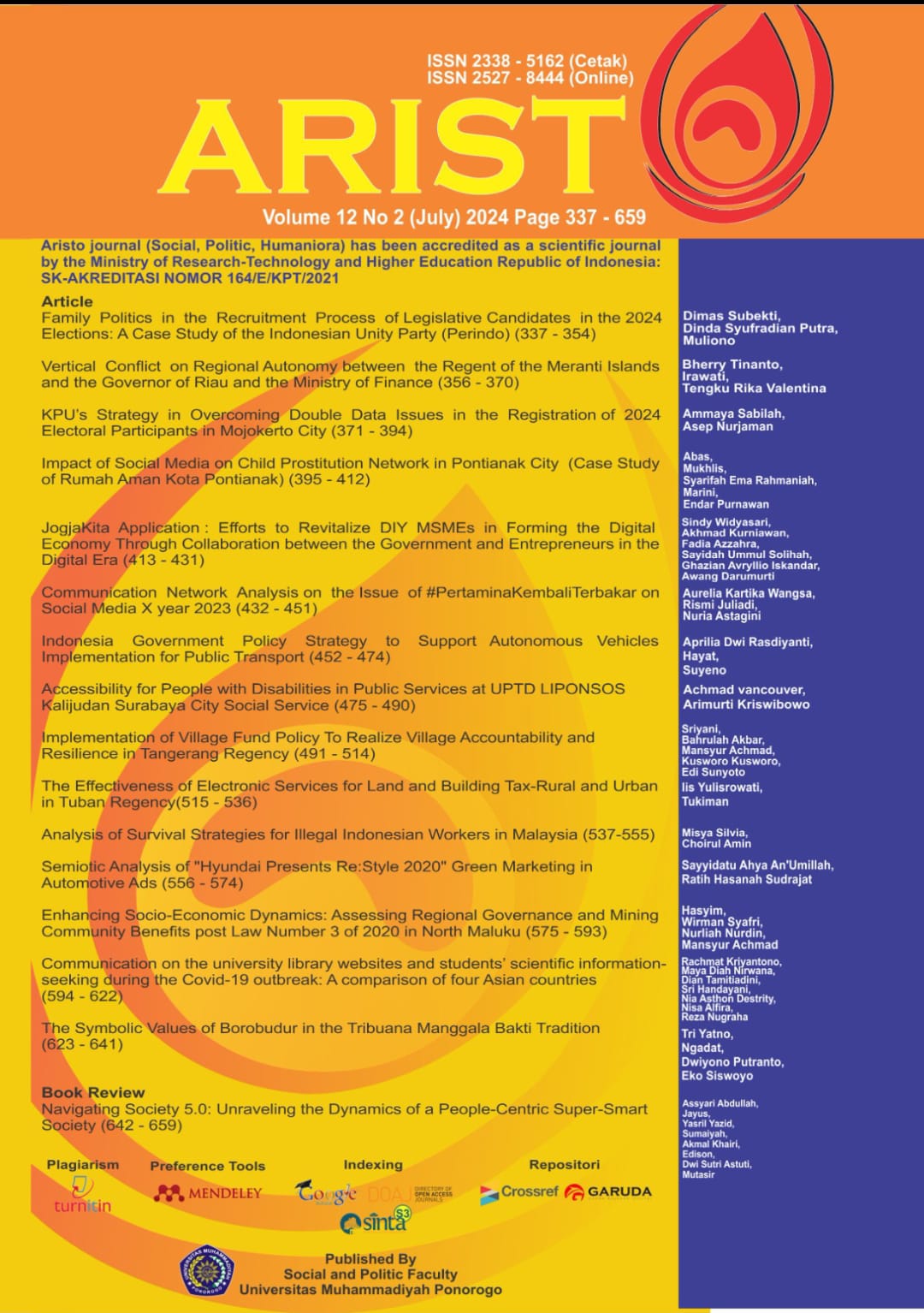
Downloads
Published
Issue
Section
License
Authors Who Publish whit this journal agree to the following term :
Copyright on any article is retained by the Journal
- Author grant the journal right of first publication with the work simultaneously licensed under a Creative Commons Attribution License that allows others to share the work with an acknowledgement of the work's authorship and initial publication in this;
- Authors are able to enter into separate, additional contractual arrangements for the non-exclusive distribution of the journal's published version of the work (e.g., post it to an institutional repository or publish it in a book), with an acknowledgement of its initial publication in this journal;
- Authors are permitted and encouraged to post their work online (e.g., in institutional repositories or on their website) prior to and during the submission process, as it can lead to productive exchanges, as well as earlier and greater citation of published work;
- Every accepted manuscript should be accompanied by Copyright Transfer Agreement (CTA), prior to the article publication. CTA can be downloaded here;
=====================================================================================================
Penulis yang mempublikasikan naskahnya pada Jurnal ini menyetujui ketentuan berikut:
Hak cipta pada setiap artikel adalah milik jurnal.
- Penulis mengakui bahwa Jurnal ARISTO berhak sebagai mempublikasikan pertama kali dengan bekerja secara bersamaan dibawah Creative Commons Attribution License yang memungkinkan orang lain untuk membagi pekerjaan dengan pengakuan dari pengarang dan publikasi pertama dalam jurnal ARISTO;
- Penulis dapat memasukan tulisan secara terpisah, mengatur distribusi non-ekskulif  dari naskah yang telah terbit di jurnal ini kedalam versi yang lain (misal: dikirim ke respository institusi penulis, publikasi kedalam buku, dll), dengan mengakui bahwa naskah telah terbit pertamakali pada Jurnal ARISTO;
- Penulis diperbolehkan dan didorong untuk mengirimkan pekerjaan mereka secara daring (misal melalui respositories atau website instansi penulis) sebelum atau selama proses pengiriman pada Jurnal ARISTO berlangsung, ini dapat menjadikan pertukaran informasi yang sangat produktif, dan serta menjadikan kutipan yang banyak dari publikasi;
- Setiap naskah yang diterima wajib menyertakan Perjanjian Pemindahan Hakcipta (Copyright Transfer Agreement/CTA), sebelum artikel diterbitkan. CTA dapat diunduh di sini


