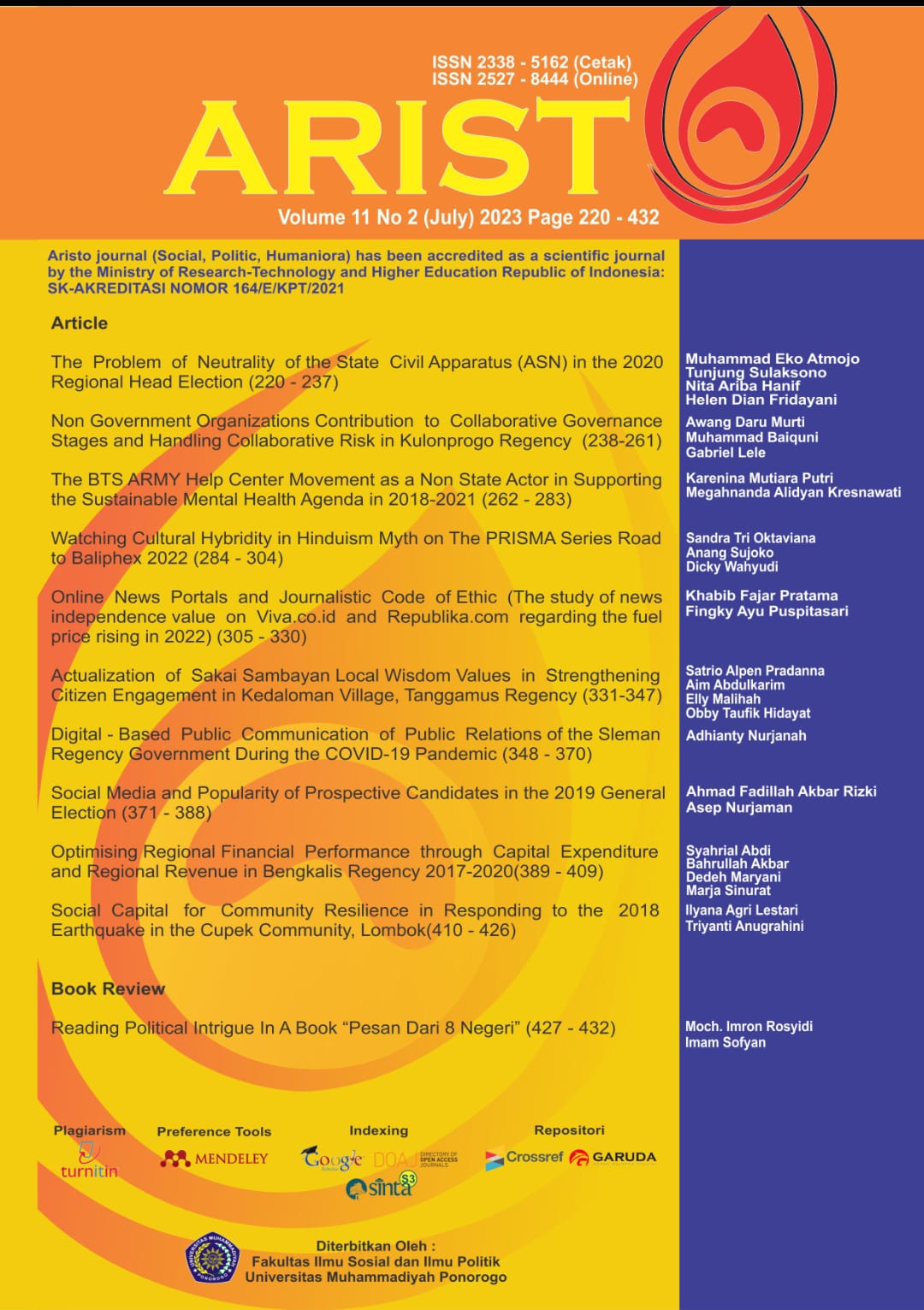
Non Government Organizations Contribution to Collaborative Governance Stages and Handling Collaborative Risk in Kulonprogo Regency
DOI:
https://doi.org/10.24269/ars.v11i2.6633Abstract
This study aims to determine the contribution of Non-Government Organizations (NGOs) in the implementation of the tobacco control policy in Kulonprogo Regency based on the stages of collaboration, the risks of collaboration and the actions taken to overcome these risks. This study uses a qualitative method with a descriptive approach. Sources of data in this study used data from interviews, previous research and online mass media news data.Based on result study, NGO have contribution in every collaboration stages. This study measures collaboration based on the stages of collaboration including brainstorming, initial collaboration, maturation of thought, and implementation. NGO have contribution in every collaboration stages. The synergy between MTCC, The Union, and the Government of Kulonprogo also experienced several problems such as administrative problems, transparency, differences in vision and mission, recruitment of members that did not comply with the rules, and lack of coordination between institutions, especially the Regional Apparatus Organizations (OPD). The risks resulting from these problems include temporary suspension of collaboration activities, internal conflicts, incompetent members, difficulty in inter-agency coordination, and financial abuse. Overcoming this problem, the actors involved in the collaboration took several actions such as revising regulations and organizational structures, tightening the member recruitment process, improving communication and coordination, as well as collaborating in financial supply.
Downloads
References
Ansell, Chris, & Gash, A. (2008). Collaborative governance in theory and practice. Journal of Public Administration Research and Theory, 18(4), 543–571. https://doi.org/https://doi.org/https://doi.org/10.1093/jopart/mum032
Ansell, Chris, & Gash, A. (2018). Collaborative governance in theory and practice. Journal of Public Administration Research and Theory, 18(4), 543–571. https://doi.org/https://doi.org/10.1093/jopart/mum032
Ansell, Christopher, Doberstein, C., Henderson, H., Siddiki, S., & ‘t Hart, P. (2020). Understanding inclusion in collaborative governance: a mixed methods approach. Policy and Society, 1–22. https://doi.org/https://doi.org/10.1080/14494035.2020.1785726
Ansell, C., & Gash, A. (2018). Collaborative Platforms as a Governance Strategy. Journal of Public Administration Research and Theory, 28(1), 16–32. https://doi.org/10.1093/jopart/mux030
Ben Yahia, N., Eljaoued, W., Bellamine Ben Saoud, N., & Colomo-Palacios, R. (2021). Towards sustainable collaborative networks for smart cities co-governance. International Journal of Information Management. https://doi.org/https://doi.org/10.1016/j.ijinfomgt.2019.11.005
Berman, H. (2010). The McNerney Forum Meeting Community Needs. 186–198.
Bianchi, C., Nasi, G., & Rivenbark, W. C. (2021). Implementing collaborative governance: models, experiences, and challenges. Public Management Review, 23(11), 1581–1589. https://doi.org/10.1080/14719037.2021.1878777
Bradford, N. (2015). Ideas and Collaborative Governance: A Discursive Localism Approach. Urban Affairs Review, 52(5), 659–684. https://doi.org/10.1177/1078087415610011
Bryson, J. M., Crosby, B. C., & Seo, D. (2020). Using a design approach to create collaborative governance. Policy & Politics, 48(1), 167–189. https://doi.org/10.1332/030557319X15613696433190
Bryson, J. M., Crosby, B. C., & Stone, M. M. (2006). The design and implementation of cross-sector collaborations: Propositions from the literature. Public Administration Review, 66(SUPPL. 1), 44–55. https://doi.org/10.1111/j.1540-6210.2006.00665.x
Carr, J. B., Hawkins, C. V, & Westberg, D. E. (2017). An Exploration of Collaboration Risk in Joint Ventures: Perceptions of Risk by Local Economic Development Officials. Economic Development Quarterly, 31(3), 210–227. https://doi.org/10.1177/0891242417710325
Darumurti, A. (2022a). Increasing the Role of Non-state Actors. Atlantis Press SARL. https://doi.org/https://doi.org/10.2991/978-2-494069-65-7
Darumurti, A. (2022b). Increasing the Role of Non-state Actors. Atlantis Press SARL. https://doi.org/10.2991/978-2-494069-65-7
Dobbin, K. B., & Lubell, M. (2021). Collaborative Governance and Environmental Justice: Disadvantaged Community Representation in California Sustainable Groundwater Management. Policy Studies Journal, 49(2), 562–590. https://doi.org/10.1111/psj.12375
Hansen, K., Mullin, M., & Riggs, E. K. (2020). Collaboration Risk and the Choice to Consolidate Local Government Services. Perspectives on Public Management and Governance, 3(3), 223–238. https://doi.org/10.1093/ppmgov/gvz017
Hudson, B., Harney, M., Prime, D., & Caldow, J. (2013). Book Reviews. British Journal of Hospital Medicine.
Huxham, C., Vangen, S., Huxham, C., & Eden, C. (2000). The Challenge of Collaborative Governance. Public Management: An International Journal of Research and Theory, 2(3), 337–358. https://doi.org/10.1080/14719030000000021
Ilmaskal, R., Prbandari, Y. S., & W., T. A. (2017). Evaluasi Penerapan Kebijakan Peraturan Daerah Kawasan Tanpa Rokok Di Kota Padang Panjang. 33(5), 257–262.
Johnston, E. W., Hicks, D., Nan, N., & Auer, J. C. (2011). Managing the Inclusion Process in Collaborative Governance. Journal of Public Administration Research and Theory, 21(4), 699–721. https://doi.org/10.1093/jopart/muq045
Juanita. (2014). Proses Pembentukan Peraturan Daerah Tentang Kawasan Tanpa Rokok di Kota Medan Tahun 2013. Kebijakan Kesehatan Indonesia, 3(4), 192–198.
Kim, S. Y., Swann, W. L., Weible, C. M., Bolognesi, T., Krause, R. M., Park, A. Y. S., Tang, T., Maletsky, K., & Feiock, R. C. (2022). Updating the Institutional Collective Action Framework. Policy Studies Journal, 50(1), 9–34. https://doi.org/10.1111/psj.12392
Lahat, L. (2020). New Institutionalism in Public Policy. Global Encyclopedia of Public Administration, Public Policy, and Governance, 1–4. https://doi.org/10.1007/978-3-319-31816-5_3879-1
Lasker, R. D., Weiss, E. S., & Miller, R. (2001). Partnership Synergy: A Practical Framework for Studying and Strengthening the Collaborative Advantage. Milbank Quarterly, 79(2), 179–205. https://doi.org/https://doi.org/10.1111/1468-0009.00203
Lecy, J. D., & Van Slyke, D. M. (2013). Nonprofit sector growth and density: Testing theories of government support. Journal of Public Administration Research and Theory, 23(1), 189–214. https://doi.org/https://doi.org/10.1093/jopart/mus010
Lumineau, F., Wang, W., & Schilke, O. (2021). Organization Science Blockchain Governance — A New Way of Organizing Collaborations ? Blockchain Governance — A New Way of Organizing Collaborations ? February 2023.
Mardhiati, R., Fatimah, N., & Andayani, N. (2017). Dukungan Perokok Dan Bukan Perokok Terhadap Kebijakan Pengendalian Tembakau Di Kota Denpasar Dan Yogyakarta. ARKESMAS (Arsip Kesehatan Masyarakat), 1(2), 75–82.
Mendel, S. C., & Brudney, J. L. (2012). Putting the NP in PPP. Public Performance & Management Review, 35(4), 617–642. https://doi.org/10.2753/PMR1530-9576350403
Miles, M. B., Huberman, A. M., & Saldaña, J. (2018). Qualitative Data Analysis A Methods Sourcebook. In Qualitative Data Analysis A Methods Sourcebook (3rd ed.). Arizona State University. https://doi.org/10.7748/ns.30.25.33.s40
Nasution, M. F. I. (2018). Penerapan Peraturan Daerah (Perda) Nomor 3 Tahun 2014 Tentang Kawasan Tanpa Rokok di Institusi Pelaksana Layanan Publik (Kepolisian Daerah Sumatera Utara, Sun Plaza dan RSU Dr.Pirngadi Medan). http://repositori.usu.ac.id/handle/123456789/4364
Nurdin, Z. (2016). Inovasi Program Kawasan Bebas Asap Rokok Di Desa Bone-Bone Kecamatan Baraka Kabupaten Enrekang. https://core.ac.uk/
Payton, E., Khubchandani, J., Thompson, A., & Price, J. H. (2017). Parents’ Expectations of High Schools in Firearm Violence Prevention. Journal of Community Health, 42(6), 1118–1126. https://doi.org/10.1007/s10900-017-0360-5
Peters, B. G. (2020). Designing institutions for designing policy. Policy and Politics, 48(1), 323–339. https://doi.org/https://doi.org/https://doi.org/10.1080/13549831003677704
Portney, K. E., & Cuttler, Z. (2010). The local nonprofit sector and the pursuit of sustainability in american cities: A preliminary exploration. Local Environment, 15(4), 323–339. https://doi.org/https://doi.org/10.1080/13549831003677704
Pozil, S. (2015). Successful Informal Partnerships Between Nonprofit Organizations and Local Governments in a Metropolitan Area.
Purdy, J. M. (2012). A Framework for Assessing Power in Collaborative Governance Processes [ with Commentary ] Published by : Wiley on behalf of the American Society for Public Administration Stable. Public Administration Review, 72(3), 409–417.
Riski, L., Setiana, W., & Astuti, D. R. (2018). Manajemen Kampanye Bahaya Merokok melalui Iklan Layanan Masyarakat Televisi. Humas: Jurnal Ilmu Hubungan Masyarakat, 3(4), 21–39. http://jurnal.fdk.uinsgd.ac.id/index.php/reputation/article/view/514
Rochadi, R. (2005). Berbagai Upaya Penanggulangan Perilaku Merokok di Indonesia. Jurnal Kesehatan Masyarakat USU, IX(2), 125–159.
Terman, J. N., Feiock, R. C., & Youm, J. (2020). When Collaboration Is Risky Business: The Influence of Collaboration Risks on Formal and Informal Collaboration. American Review of Public Administration, 50(1), 33–44. https://doi.org/10.1177/0275074019867421
Tsui, E., Bylander, K., Cho, M., Maybank, A., & Freudenberg, N. (2012). Engaging youth in food activism in New York city: Lessons learned from a youth organization, health department, and university partnership. Journal of Urban Health, 89(5), 809–827. https://doi.org/https://doi.org/10.1007/s11524-012-9684-8
Waardenburg, M., Groenleer, M., de Jong, J., & Keijser, B. (2020). Paradoxes of collaborative governance: investigating the real-life dynamics of multi-agency collaborations using a quasi-experimental action-research approach. Public Management Review, 22(3), 386–407. https://doi.org/10.1080/14719037.2019.1599056
Weymouth, Robert, Hartz-, Karp, J., Weymouth, R., & Hartz-Karp, J. (2015). Deliberative Collaborative Governance as a Democratic Reform to Resolve Wicked Problems and Improve Trust. Journal of Economic and Social Policy, 17(1), 1–32. http://epubs.scu.edu.au/jesp%0Ahttp://epubs.scu.edu.au/jesp/vol17/iss1/4
Witesman, E. M., & Fernandez, S. (2013). Government Contracts With Private Organizations: Are There Differences Between Nonprofits and For-profits? Nonprofit and Voluntary Sector Quarterly, 42(4), 689–715. https://doi.org/https://doi.org/https://doi.org/10.1177/0899764012442592
Yang, L. (2017). Types and Institutional Design Principles of Collaborative Governance in a Strong-Government Society: The Case Study of Desertification Control in Northern China. International Public Management Journal. https://doi.org/https://doi.org/10.1080/10967494.2016.1141812
Yusuf, M. R., & Internasional, D. H. (2016). Investigasi Advokasi Pengendalian Tembakau di Indonesia : Studi Kasus TCSC Jawa Timur. Jurnal Analisis Hubungan Internasional, 5(2), 438–449. http://journal.unair.ac.id/download-fullpapers-jahie6b5f4d1e3full.pdf
Zaenuri, M. (2016). Tata kelola pariwisata-bencana dalam perpektif collaborative governance studi pariwisata-bencana volcano tour merapi di kabupaten Sleman [Repository.Umy.Ac.Id]. http://repository.umy.ac.id/bitstream/handle/123456789/6446/PAPER SEMINAR HASIL PENELITIAN_zaenuri.pdf?sequence=1
Downloads
Published
Issue
Section
License
Authors Who Publish whit this journal agree to the following term :
Copyright on any article is retained by the Journal
- Author grant the journal right of first publication with the work simultaneously licensed under a Creative Commons Attribution License that allows others to share the work with an acknowledgement of the work's authorship and initial publication in this;
- Authors are able to enter into separate, additional contractual arrangements for the non-exclusive distribution of the journal's published version of the work (e.g., post it to an institutional repository or publish it in a book), with an acknowledgement of its initial publication in this journal;
- Authors are permitted and encouraged to post their work online (e.g., in institutional repositories or on their website) prior to and during the submission process, as it can lead to productive exchanges, as well as earlier and greater citation of published work;
- Every accepted manuscript should be accompanied by Copyright Transfer Agreement (CTA), prior to the article publication. CTA can be downloaded here;
=====================================================================================================
Penulis yang mempublikasikan naskahnya pada Jurnal ini menyetujui ketentuan berikut:
Hak cipta pada setiap artikel adalah milik jurnal.
- Penulis mengakui bahwa Jurnal ARISTO berhak sebagai mempublikasikan pertama kali dengan bekerja secara bersamaan dibawah Creative Commons Attribution License yang memungkinkan orang lain untuk membagi pekerjaan dengan pengakuan dari pengarang dan publikasi pertama dalam jurnal ARISTO;
- Penulis dapat memasukan tulisan secara terpisah, mengatur distribusi non-ekskulif  dari naskah yang telah terbit di jurnal ini kedalam versi yang lain (misal: dikirim ke respository institusi penulis, publikasi kedalam buku, dll), dengan mengakui bahwa naskah telah terbit pertamakali pada Jurnal ARISTO;
- Penulis diperbolehkan dan didorong untuk mengirimkan pekerjaan mereka secara daring (misal melalui respositories atau website instansi penulis) sebelum atau selama proses pengiriman pada Jurnal ARISTO berlangsung, ini dapat menjadikan pertukaran informasi yang sangat produktif, dan serta menjadikan kutipan yang banyak dari publikasi;
- Setiap naskah yang diterima wajib menyertakan Perjanjian Pemindahan Hakcipta (Copyright Transfer Agreement/CTA), sebelum artikel diterbitkan. CTA dapat diunduh di sini


