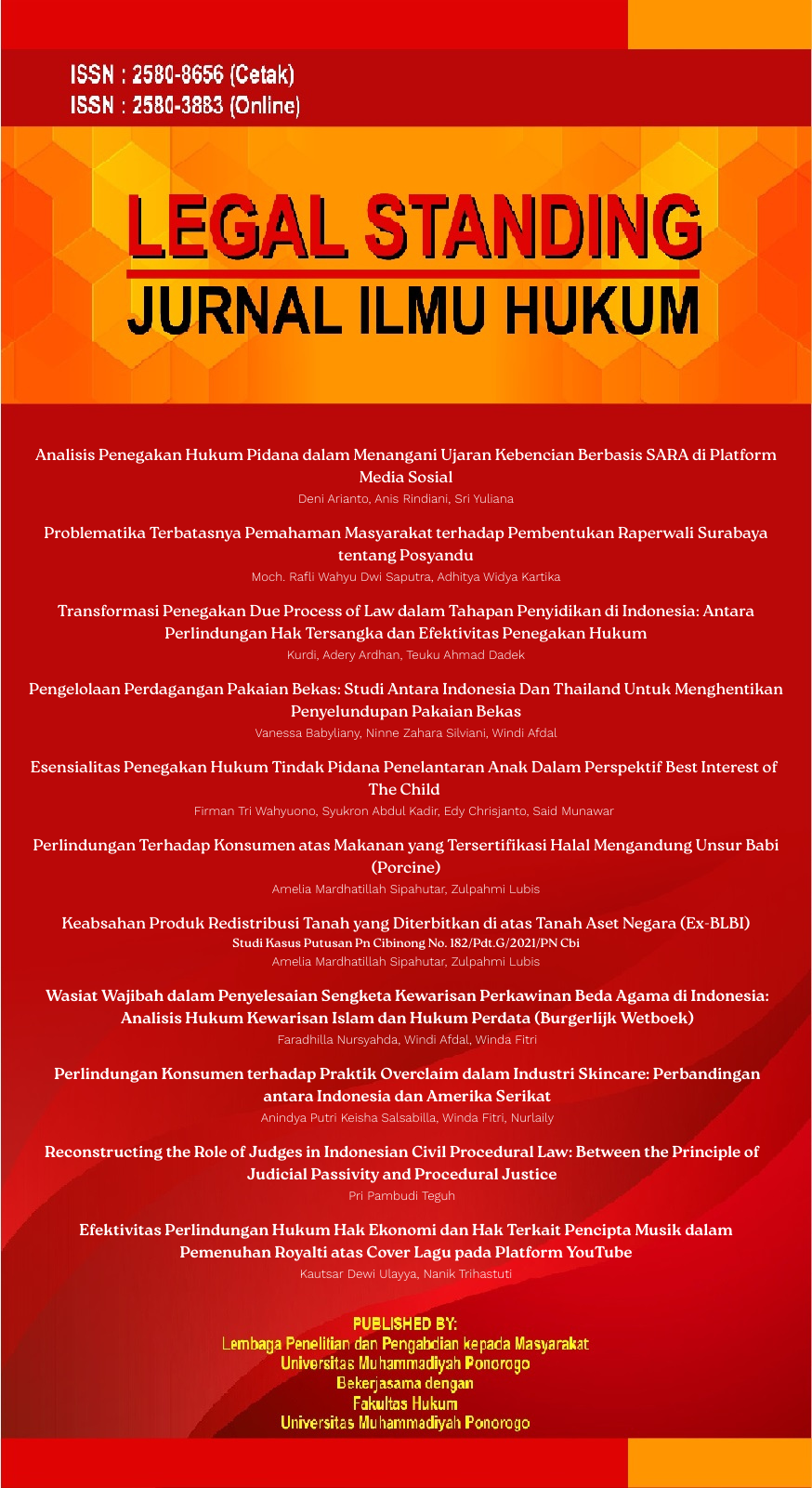
Reconstructing the Role of Judges in Indonesian Civil Procedural Law: Between the Principle of Judicial Passivity and Procedural Justice
DOI:
https://doi.org/10.24269/ls.v10i1.13393Keywords:
Civil Procedure Law, Judge, Procedural JusticeAbstract
Indonesian civil procedural law remains strongly influenced by colonial legal paradigms that position judges as passive actors strictly bound by the parties’ claims. In judicial practice, the formalistic application of the passive judge principle frequently generates problems of procedural justice, particularly when litigation is terminated on procedural grounds without substantive examination. This condition is problematic within a rule-of-law framework that requires courts to uphold justice and the protection of rights. This study aims to examine the normative construction of the passive judge principle in Indonesian civil procedure and to formulate a reconstruction of the judicial role capable of ensuring procedural justice without undermining judicial impartiality and legal authority. This research employs normative legal research using statutory and conceptual approaches, analyzed through qualitative descriptive methods. The findings indicate that the passive judge principle cannot be interpreted absolutely, as it must be understood systemically within the framework of the rule of law and the purposes of law. Furthermore, a reconstruction of the judicial role through the measured use of judicial discretion is necessary to prevent civil litigation from being trapped in procedural formalism and to ensure a balanced realization of justice, legal certainty, and utility.
Downloads
References
Alexy, R., Paulson, B. L., & Paulson, S. L. (2002). The argument from injustice: a reply to legal positivism. Oxford: Oxford University Press.
Amiruddin & Asikin, Z. (2018). Pengantar metode penelitian hukum. Jakarta: Raja Grafindo Persada.
Asshiddiqie, J. (2005). Konstitusi dan konstitusionalisme Indonesia. Jakarta: Konstitusi Press.
Cappelletti, M. (2017). The judicial process in comparative perspective. Oxford: Clarendon Press.
Fajar, M. N., & Achmad, Y. (2010). Penelitian Hukum Normatif dan Empiris. Yogyakarta: Pustaka Pelajar.
Galligan, D. J. (2018). Discretionary powers: A legal study of official discretion. Oxford: Oxford University Press.
Indonesia. (1945). Undang-Undang Dasar Negara Republik Indonesia Tahun 1945.
Indonesia. (1847). Burgerlijk Wetboek voor Indonesië (Staatsblad No. 23 of 1847).
Indonesia. (2009). Undang-Undang Republik Indonesia Nomor 48 Tahun 2009 tentang Kekuasaan Kehakiman.
Indonesia. (1941). Het Herziene Indonesisch Reglement (Staatsblad 1941 No. 44)
Indonesia. (1927). Rechtsreglement voor de Buitengewesten (Staatsblad 1927 No. 227).
Marda, G., Dewangga, V., Musyaffa, R. A., & Kinanti, C. S. (2023). Pembuktian Hukum Acara Perdata Melalui Pengetahuan Hakim. Jurnal Magister Ilmu Hukum: Hukum dan Kesejahteraan, 8(2), 35-49. http://dx.doi.org/10.36722/jmih.v8i2.2306
Martana, N. A. (2016). Hukum acara dan praktik peradilan perdata. Denpasar: Fakultas Hukum Universitas Udayana.
Mertokusumo, S. (2002). Hukum acara perdata Indonesia. Yogyakarta: Liberty.
Muhaimin. (2020). Metode penelitian hukum. Mataram: Mataram University Press.
Radbruch, G. (2006). Statutory lawlessness and supra-statutory law (1946). Oxford Journal of Legal Studies, 26(1), 1-11. https://doi.org/10.1093/ojls/gqi041
Salim, H. S., & Nurbani, E. S. (2014). Penerapan teori hukum pada penelitian tesis dan disertasi (1st ed., 3rd printing). Jakarta: Rajawali Pers.
Sari, M. P., & Aprillia, W. (2025). Analisis hukum tentang proses litigasi dalam kasus perdata di Indonesia. CAUSA: Jurnal Hukum dan Kewarganegaraan, 11 (12).
Sibuea, H. P. (2006). Kekuasaan kehakiman Indonesia. Jakarta: Krakatau Book.
Sunarto, S. (2016). Prinsip Hakim Aktif Dalam Perkara Perdata. Jurnal Hukum dan Peradilan, 5(2), 249-276. https://doi.org/10.25216/jhp.5.2.2016.249-276
Syarief, E. (2020). Praktik Peradilan Perdata. Jakarta: Kencana.
Tyler, T. R. (2006). Why people obey the law. Princeton: Princeton University Press.
Downloads
Published
How to Cite
Issue
Section
License

Legal Standing : (Jurnal Ilmu Hukum) is licensed under a Lisensi Creative Commons Atribusi-BerbagiSerupa 4.0 Internasional.
.png)