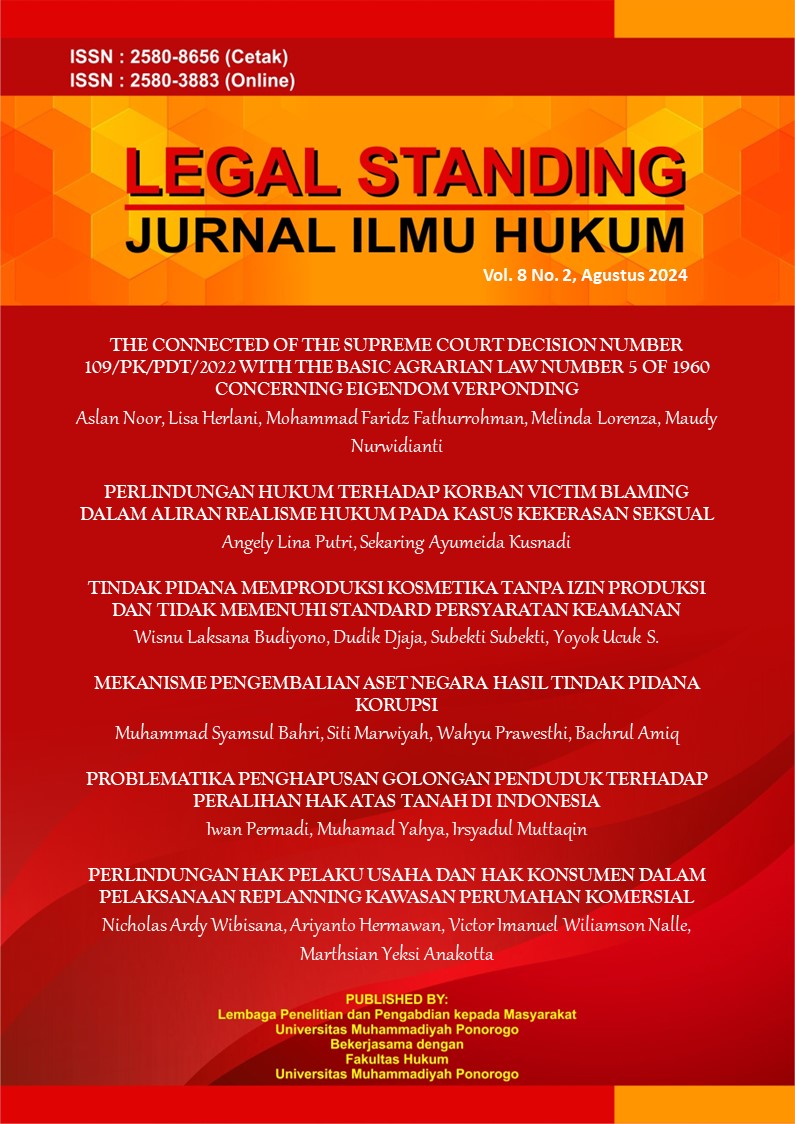
MEKANISME PENGEMBALIAN ASET NEGARA HASIL TINDAK PIDANA KORUPSI
DOI:
https://doi.org/10.24269/ls.v8i2.8916Abstract
Corruption is a despicable act that occurs every year. Corruption is classified as a heinous act and has a major impact on state finances, causing harm to many parties. Investigation, prosecution and court hearings in corruption cases must take priority over other cases in order to resolve them as quickly as possible. The aim of this research is to understand and analyze law enforcement for criminal acts of corruption in Indonesia and to understand and analyze the mechanism for returning state assets resulting from criminal acts of corruption. The method used in this research is a normative research method. It is a legal research which places the law as a building system of norms. Law Number 20 of 2001 concerning Corruption Crimes regulates mechanisms or procedures that can be used to return assets through criminal and civil channels. The mechanism for returning state assets resulting from criminal acts of corruption can be carried out using two mechanisms, which is criminal route as regulated in UNCAC and the civil route (civil forfeiture). The criminal route is intended to provide a deterrent effect to corruptors so that they do not repeat criminal acts of corruption. Civil forfeiture is intended to return state assets resulting from criminal acts of corruption with evidence obtained from the criminal process, namely tracing and freezing assets. The key to success lies with each country, so it cannot be determined which mechanism is the best. Elements of success in efforts to return assets resulting from criminal acts of corruption must take into account several factors, one of which is the perspective that the law enforcement approach in Indonesia still focuses on punishing perpetrators (in personam), not confiscating assets resulting from crime.
Downloads
References
Basrief, A. (2006). Korupsi dan Upaya Penegakan Hukum (Kapita Selekta). Adika Remaja Indonesia.
Candra, D., & Arfin. (2018). Kendala Pengembalian Aset Hasil Tindak Pidana Korupsi Transnasional. Jurnal BPPK, 11(1), 28–55.
Flynn, J. (2023, June 14). 20 Shocking White-Collar Crime Statistics [2023]: The State Of White Collar Crime In The U.S.
Halawa, F., & Setiadi, E. (2016). Korupsi dengan Nilai Kerugian Sedikit. Unisba.
Hamamah, F., & Bahtiar, H. H. (2019). Model Pengembalian Aset (Asset Recovery) Sebagai Alternatif Memulihkan Kerugian Negara Dalam Perkara Tindak Pidana Korupsi. Jurnal Kajian Hukum Islam, 4(2).
Hamzah, A. (2007). Pemberantasan Korupsi Melalui Hukum Pidana Nasional dan Internasional. PT Raja Grafindo Persada.
Hartanti, E. (2009). Tindak Pidana Korupsi. Sinar Grafika.
Hasanah, L. (2021). Upaya Pengembalian Aset Negara: Wujud Pemberantasan Tindak Pidana Korupsi. Jurnal Anti Korupsi, 3(2), 41–55. https://doi.org/10.19184/jak.v3i2.28922
Husodo, A. T. (2010). Catatan Kritis Atas Usaha Pengembalian Aset Hasil Tindak Pidana Korupsi. Jurnal Legislasi Indonesia: Perampasan Aset Hasil Tindak Pidana, 598–599.
Ibrahim, J. (2006). Teori dan Metodologi Penelitian Hukum Normatif. Bayu Publishing.
Ismail. (2013). Fungsi Penyidik KPK dalam Pemberantasan Tindak Pidana Korupsi Berdasarkan Undang-Undang Nomor 30 Tahun 2002.
Kulish, A., Andriichenko, N., & Reznik, O. (2018). A step forward in the minimization of political corruption in financial support of political parties: The experience of Ukraine and Lithuania. Baltic Journal of Law and Politics, 11(1), 108–130. https://doi.org/10.2478/bjlp-2018-0005
Mahmud, P., & Marzuki. (2006). Penelitian Hukum. Kencana.
Michel, C., & Galperin, B. L. (2023). Profiling the modern white-collar criminal: An overview of Utah’s white-collar crime registry. In Business Horizons (Vol. 66, Issue 5, pp. 573–583). Elsevier Ltd. https://doi.org/10.1016/j.bushor.2022.11.003
Oluseye, O. (2024). Exploring potential political corruption in large-scale infrastructure projects in Nigeria. Project Leadership and Society, 5, 100108. https://doi.org/10.1016/j.plas.2023.100108
Pradjonggo, T. S. (2010). Sifat Melawan Hukum dalam Tindak Pidana Korupsi. Indonesia Lawyer Club.
Prakarsa, A., & Yulia, R. (2017). Model Pengembalian Aset (Asset Recovery) sebagai Alternatif Memulihkan Kerugian Negara dalam Perkara Tindak Pidana Korupsi. Jurnal Hukum PRIORIS, 6(1), 31–45.
Rahardjo, S. (1982). Masalah Penegakan Hukum: Suatu Tinjauan Sosiologis. Sinar Baru.
Rais, A. (1999). Pengantar. Menyikapi Korupsi, Kolusi, Dan Nepotisme Di Indonesia.
Sari, E. M. (2010). Mekanisme Pengembalian Aset Hasil Tindak Pidana Korupsi. Jurnal Legislasi: Perampasan Aset Hasil Tindak Pidana.
Sosiawan, U. M. (2020). Penanganan Pengembalian Aset Negara Hasil Tindak Pidana Korupsi dan Penerapan Konvensi PBB Anti Korupsi di Indonesia. Jurnal Penelitian Hukum De Jure, 20(4), 587. https://doi.org/10.30641/dejure.2020.v20.587-604
Utama, P. (2013). Terobosan UNCAC dalam Pengembalian Aset Korupsi Melalui Kerja Sama Internasional. Kencana.
Yanuar, P. M. (2007). Pengembalian Aset Korupsi Berdasarkan Konvensi PBB Anti Korupsi 2003 Dalam Sistem Hukum Indonesia. Alumni.
Yusuf, M. (2010). Pengembalian Hasil Tindak Pidana Korupsi Melalui NCB ASSET FORFEITURE. Jurnal Legislasi Indonesia: Perampasan Aset Hasil Tindak Pidana.
Downloads
Published
How to Cite
Issue
Section
License

Legal Standing : (Jurnal Ilmu Hukum) is licensed under a Lisensi Creative Commons Atribusi-BerbagiSerupa 4.0 Internasional.
.png)